By: Jack Mercer
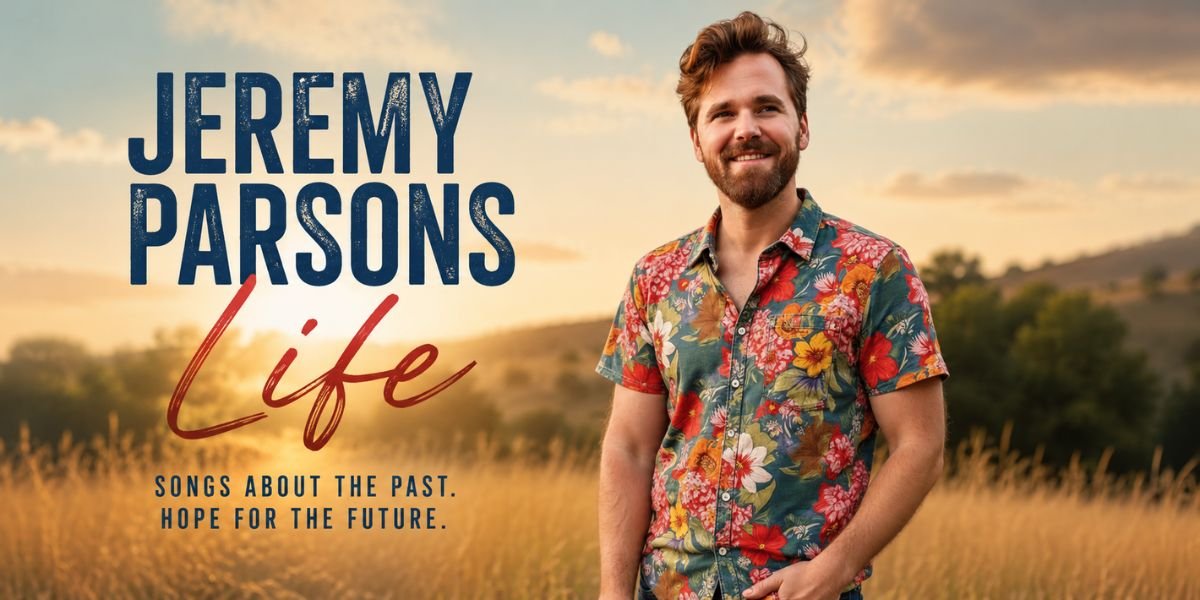
Some records announce themselves with bombast. Others earn their place through patience. Jeremy Parsons’ Life belongs squarely in the latter category, a five-song EP that doesn’t chase trends or radio formulas so much as it documents the quiet evolution of a songwriter who’s learned that vulnerability can be more compelling than certainty.
For the better part of a decade, the Texas-born singer-songwriter has built an impressive independent career by staying remarkably consistent in one respect: writing songs that prioritize honesty over spectacle. His catalog has produced international chart success, including the iTunes Country No. 1 “Burn This House Down,” over a million streams, and growing critical acclaim. But Life may be the record that best explains why listeners continue returning to Parsons’ music. It’s less concerned with career milestones than personal ones.
Written during the isolation of the pandemic, Life feels like an artist’s journal left open on the kitchen table. The world outside had become uncertain, concerts disappeared overnight, and like so many musicians, Parsons found himself confronting something unfamiliar: stillness. Rather than fight it, he listened to it.
The result is an EP that examines time, identity, compassion, and redemption without ever becoming self-important.
Opening track “Tickin'” immediately establishes the record’s emotional core. Built around the simple image of a clock on the wall, the song explores mortality without melodrama. Parsons sings, “It’s not wasted if you choose to learn,” turning what could have been another familiar meditation on passing time into something more nuanced. This isn’t about fearing the future. It’s about accepting the past.
Musically, the arrangement reflects Parsons’ strengths. Acoustic textures, understated production, and melodic restraint allow the songwriting to remain the centerpiece. There’s enough country in the DNA to satisfy traditionalists, enough Americana to appeal beyond Nashville, and enough pop sensibility to make the hooks linger after the final chorus.
That balance continues on “The Garden,” one of the EP’s finest moments. Inspired by his father, a horticulturist, Parsons transforms planting and cultivation into a metaphor for emotional growth. Lesser writers might have leaned into sentimentality, but Parsons avoids easy emotional cues. Instead, the repeated line “I hope that means you are too” lands with quiet sincerity. It’s less a lyric than a wish.
The emotional centerpiece, however, is “Who Was I.”
Here, Parsons delivers his most revealing performance. Looking back at his younger self, a version marked by drifting, substance use, uncertainty, and relentless pursuit of a dream, he refuses both self-pity and self-congratulation. “Sometimes I wonder who’s chasing who, me or the dream,” he sings, distilling years of ambition into one devastating question.
It’s a reminder that Parsons has always been at his strongest when writing about the uncomfortable spaces between success and failure. The song resonates because it acknowledges that growth isn’t linear. Sometimes, the person you become only makes sense because of the person you survived.
“Humanity” broadens the lens, addressing the social fractures that became impossible to ignore during the years these songs were written. Parsons examines polarization, judgment, and empathy with restraint rather than outrage. His observations are thoughtful instead of polemical, suggesting that understanding begins with listening rather than shouting.
By the time “Life Worth Dyin’ For” closes the EP, Parsons has earned every word. The title could have collapsed under its own philosophical weight, but instead, it becomes a graceful summation of everything that came before. Love, failure, laughter, regret, perseverance, they’re all necessary chapters in a meaningful existence. The song isn’t an ending so much as an acceptance.
What makes Life particularly compelling is where it arrives in Parsons’ own journey. Following years of touring, chart success, and international recognition, he recently entered a new personal chapter with his marriage. That context gives these songs additional resonance. They document not simply who Parsons was during one extraordinary period of history, but the emotional foundation upon which his future is being built.
Throughout Life, Parsons demonstrates something increasingly rare in contemporary country and Americana: confidence in understatement. He trusts lyrics to carry emotional weight. He trusts melodies to unfold naturally. Most importantly, he trusts listeners to meet him halfway.
That’s not an easy proposition in today’s music scene, where bigger often masquerades as better and vulnerability is frequently confused with oversharing. Parsons takes a different route. His songs reveal themselves slowly, rewarding repeated listens rather than demanding immediate attention.
The result is an EP that feels timeless precisely because it refuses to chase the moment. Life isn’t trying to define an era; it’s trying to understand one. And in doing so, Jeremy Parsons has delivered his most emotionally complete work to date, a reminder that the strongest songs don’t always provide answers. Sometimes, they simply ask the questions we’re finally ready to hear.