By: Joe Silva
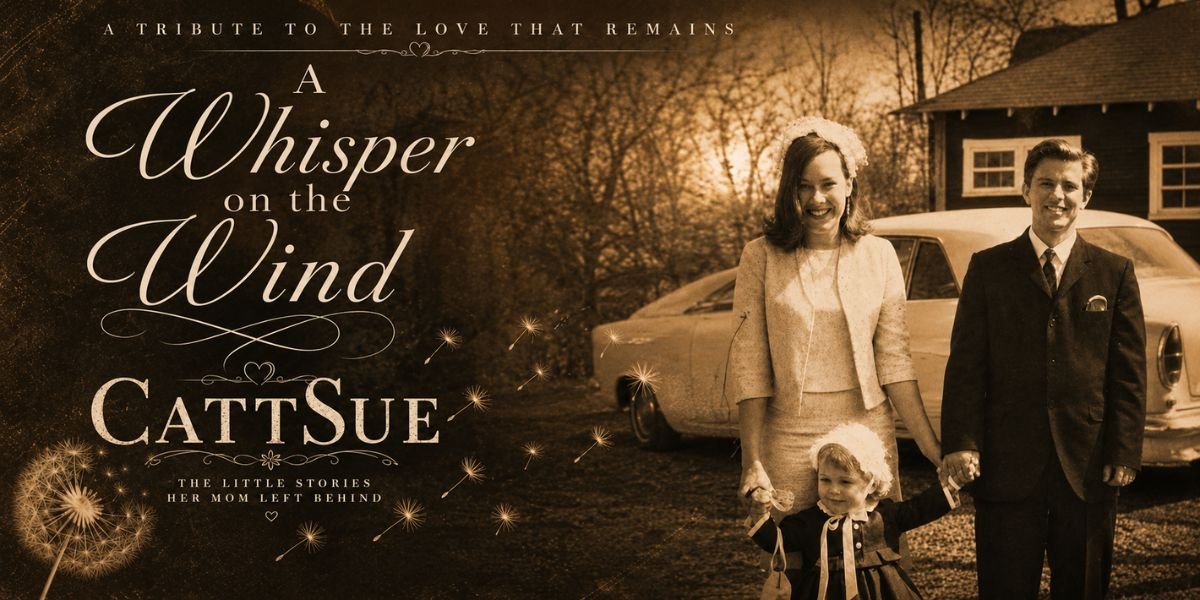
Some songs arrive with volume. Others arrive with velocity. CattSue’s “A Whisper on the Wind” arrives with neither. It enters quietly, almost cautiously, and by the time it reaches its final verse, it does something less common in popular music: it seems to earn much of the emotion it asks the listener to feel.
The Jacksonville-area singer-songwriter first drew attention with her debut single, “Come Home to Me,” a graceful introduction that received attention on the UK iTunes charts and the Independent Music Network. It hinted at an artist interested less in commercial trends than emotional authenticity. “A Whisper on the Wind” builds on that impression while revealing a songwriter willing to venture into even more vulnerable territory.
At its heart, this is a song about memory, or, perhaps more accurately, about the spaces where memory no longer exists.
CattSue lost her mother when she was only four-and-a-half years old. That’s an age when life is experienced through fragments rather than chronology, through feelings rather than explanations. Instead of attempting to dramatize that loss, she reconstructs it through vivid details that help establish trust with the listener. The mention of carrying a Mrs. Beasley doll everywhere is particularly effective. It’s the sort of image that would be difficult for a committee of professional songwriters to invent because it belongs entirely to one life. Yet, paradoxically, that specificity makes the emotion more widely relatable.
Skilled songwriters understand that listeners rarely connect to abstraction. They connect to detail.
Musically, “A Whisper on the Wind” embraces restraint. Built upon a gentle acoustic framework with subtle country and contemporary pop influences, the arrangement avoids unnecessary embellishment. Every instrument seems placed with purpose rather than excess. The production creates atmosphere without overwhelming the narrative. In today’s marketplace, where many recordings can mistake density for depth, that simplicity feels refreshing.
CattSue’s vocal performance follows the same philosophy.
She possesses neither the explosive power of a contemporary pop belter nor the stylized affectations common in today’s country radio. Instead, she sings conversationally, allowing phrasing and emotional nuance to carry the performance. There is confidence in that choice. She never sounds as though she’s trying to convince listeners that the song matters. She simply tells her story and trusts they’ll understand.
They likely will.
The chorus arrives with elegant simplicity:
“You’re my beautiful angel
Watching from above
I only had a little time
But it was enough.”
That final sentiment changes the emotional direction. Some writers might have centered the song exclusively around deprivation. CattSue instead acknowledges gratitude. Love is measured not by duration but by permanence. It remains one of the composition’s affecting insights.
Where the song distinguishes itself, however, is during its bridge.
“I wish I could remember the sound of your voice.”
It’s a devastating line precisely because it addresses an aspect of grief that often goes unspoken. We speak about missing people, but less frequently about mourning the disappearance of memory itself. Voices fade. Mannerisms disappear. Even cherished faces gradually soften around the edges of recollection.
Rather than dwelling in that heartbreak, CattSue imagines what her mother might say today: “My girl, I’m proud of you, go chase your dreams.”
It’s a risky lyrical turn. In another song, it might feel sentimental or overly convenient. Here, it feels earned because the entire composition has prepared us for it. The imagined conversation becomes less fantasy than emotional reconciliation, a daughter granting herself permission to hear the encouragement she believes always existed.
Perhaps that’s what helps make “A Whisper on the Wind” resonate.
It’s not really a song about death.
It’s a song about presence.
The title itself suggests that love survives not through certainty but through moments of quiet recognition, a breeze, a memory, a fleeting thought that arrives without explanation. CattSue never insists that listeners interpret these moments literally. Instead, she leaves room for individual experience, allowing faith, memory, and imagination to coexist.
That openness gives the song notable emotional reach.
Following the encouraging reception of “Come Home to Me,” CattSue continues to define herself as an artist whose notable strength lies in her willingness to value sincerity over spectacle. She understands that songs need not shout to command attention. Sometimes they only need to tell the truth.
“A Whisper on the Wind” is carefully crafted, emotionally thoughtful, and patient. It honors a mother’s memory without reducing grief to cliché or sentimentality. More importantly, it reminds us that one of music’s meaningful gifts isn’t simply entertainment. In its strongest moments, music can preserve what time threatens to erase.
Long after the final note fades, that’s exactly what this thoughtful single may continue to do.