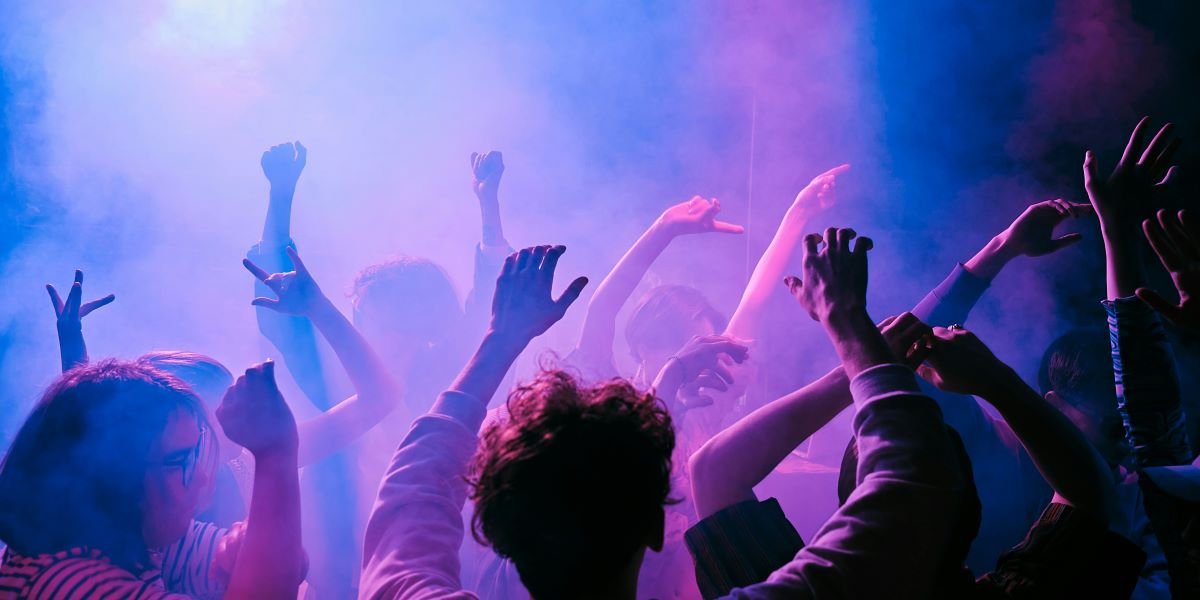
Björk hosted the Echolalia Festival on August 12 at Víðistaðatún sculpture park in Hafnarfjörður, Iceland, delivering an hour-long DJ set to approximately 7,000 attendees while a total solar eclipse passed directly overhead. Wearing an extravagant balloon gown designed by Robert Wun for his Fall 2026 Couture Collection and holding a glass of white wine, Björk spun tracks by Rosalía, Kelela, Marina Herlop, and Machine Girl as the park experienced one minute and four seconds of complete darkness when the moon fully obscured the sun at approximately 5:48 p.m. local time. The one-day festival, which also featured a DJ set from Venezuelan electronic artist Arca and performances from Icelandic and international acts, simultaneously celebrated the 40th anniversary of the Icelandic record label Smekkleysa and served as a companion event to Björk’s Echolalia exhibition at the National Gallery of Iceland, where three songs from her catalog, including one from a confirmed forthcoming album expected in 2027, are being presented on a theatrical scale through September.
Key Takeaways
- Björk performed a DJ set from 5:50 p.m. to 6:47 p.m. GMT at Víðistaðatún sculpture park in Hafnarfjörður, with her set overlapping the exact moment of totality (one minute and four seconds of complete darkness).
- Approximately 7,000 people attended the Echolalia Festival; Arca performed as the sky darkened before Björk’s headlining set.
- Björk’s set included tracks by Marina Herlop, Kelela, Machine Girl, HWXXNG, Safety Trace and Arca, and the Rosalía/Björk/Yves Tumor remix of “Berghain.”
- The festival also featured performances from 33EMYBW, Loscaballos, Ronja Jóhannsdóttir, Sideproject, Gummi Arnalds, and Knackered.
- The event celebrated the 40th anniversary of Smekkleysa, the Icelandic label co-founded by members of The Sugarcubes; all tickets included admission to Björk’s Echolalia exhibition at the National Gallery of Iceland.
- Björk has confirmed a new album for 2027, her first since Fossora (2022); one song from the forthcoming record is being presented at the exhibition alongside “Ancestress” and “Sorrowful Soil,” both composed in memory of her late mother.
An Eclipse Set Timed to the Minute
The festival’s defining feature was its synchronization with the solar eclipse. Arca performed as the sky darkened through the partial phase of the eclipse, building tension across the park as daylight gradually drained from the sculpture garden. Björk then took the decks at 5:50 p.m., with totality arriving at approximately 5:48 p.m. local time, meaning her set began in the minutes surrounding the moment of complete darkness.
The one minute and four seconds of totality, during which the moon fully covered the sun and plunged the site into nighttime conditions, occurred while Björk was playing. The timing was not accidental. The entire event was designed around the eclipse’s trajectory over western Iceland, with Víðistaðatún sitting within the path of totality. The park, located in Hafnarfjörður approximately 10 kilometers southwest of Reykjavík, offered an open-air setting where the astronomical event and the music unfolded simultaneously.
Björk’s set ran just under an hour, closing at 6:47 p.m. The tracklist drew from artists operating at the edges of electronic music, club culture, and experimental production. Marina Herlop’s “Jaque,” Kelela’s “If We Meet Again,” Machine Girl’s “Down to the Essence (Mun Sing Remix),” HWXXNG’s “Cyber Shamanism,” and Safety Trace and Arca’s “El Alma Que Te Trajo” formed the core of the selection. Björk also played the Conrad Taylor remix of “Berghain” by Rosalía, Björk, and Yves Tumor, a track she had previously performed with Rosalía at the 2026 BRIT Awards in Manchester.
The Lineup and What It Signals About Björk’s Curatorial Instincts
The Echolalia Festival lineup extended beyond the two headliners. The festival’s ticketing page listed Sideproject and Ronja Jóhannsdóttir, both Icelandic acts, alongside international artists 33EMYBW and Loscaballos. Gummi Arnalds and Knackered also performed, filling out a bill that mixed local Icelandic talent with artists from the global electronic and experimental underground.
The programming reflected the curatorial identity Björk has cultivated through her long-running Mánakvöld series, the monthly Full Moon DJ sets she has hosted at Smekkleysa’s Reykjavík location for three years. Those evenings, described in the festival’s press materials as informal dance gatherings where Björk invites friends to DJ with her, have functioned as a recurring showcase for the kind of music that Björk consumes, curates, and positions alongside her own work. The Echolalia Festival scaled that intimate format into a 7,000-person outdoor event without abandoning its underlying logic: the lineup was still built around Björk’s personal taste and community rather than commercial headliner calculus.
Arca’s presence on the bill carried particular weight. The Venezuelan producer and performer has collaborated with Björk across multiple projects and operates in a similar space of genre-resistant electronic music. Having Arca perform during the eclipse’s partial phase, as the sky dimmed but before totality, created a natural arc in which the music tracked the astronomical event’s progression toward darkness.
Smekkleysa at 40 and What the Label Means to Icelandic Music
The festival doubled as a 40th anniversary celebration for Smekkleysa (translated as “Bad Taste”), the Icelandic record label and store co-founded in 1986 by members of the country’s experimental music scene. Smekkleysa’s founding is inseparable from the history of The Sugarcubes, the band that launched Björk’s international career. The label has operated as a cultural institution in Reykjavík for four decades, functioning simultaneously as a record store, a label, and a gathering point for the Icelandic creative community.
The anniversary connection gave the festival a dimension beyond the eclipse itself. Organizers offered limited-edition collector bundles alongside festival tickets, featuring signed items, new releases, and re-releases tied to the Smekkleysa catalog. The bundles were available exclusively through the festival ticket checkout and could be picked up on-site or at the Smekkleysa Record Store in August. For artists and fans embedded in Iceland’s music scene, the Smekkleysa anniversary carries the kind of institutional significance that connects the present-day event to the broader arc of Icelandic musical identity.
The Exhibition, the New Album, and What Comes Next
All Echolalia Festival tickets included admission to Björk’s Echolalia exhibition at the National Gallery of Iceland in Reykjavík, along with a pair of custom-made approved solar eclipse glasses. The exhibition, which runs from May 30 through September 19, presents three songs on what the gallery describes as a theatrical scale. Two of them, “Ancestress” and “Sorrowful Soil,” were composed by Björk in memory of her late mother, Hildur Rúna Hauksdóttir, who died in 2018. The third is drawn from Björk’s forthcoming album, which she has confirmed for a 2027 release. It would be her first full-length since Fossora, released on September 30, 2022.
A separate exhibition, Metamorphlings, running on a parallel schedule through September 19, showcases work by James Merry, Björk’s long-time artistic collaborator known for the sculptural masks and headpieces that have defined much of her visual identity across recent album cycles.
Beyond the exhibitions and the eclipse rave, Björk’s 2026 has included a performance with Rosalía at the BRIT Awards in Manchester and work soundtracking SEED, a sci-fi multiplayer game. The convergence of these projects, a museum exhibition, a festival curated around a celestial event, a game soundtrack, a confirmed new album, and a label anniversary, represents the kind of multi-platform creative output that has characterized Björk’s career since the 1990s. The Echolalia Festival, staged under an eclipsed sun for 7,000 people in a sculpture park outside Reykjavík, was the most publicly visible expression of that output in 2026.
FAQs
What was the Echolalia Festival?
The Echolalia Festival was a one-day outdoor music event held on August 12, 2026, at Víðistaðatún sculpture park in Hafnarfjörður, Iceland, approximately 10 kilometers southwest of Reykjavík. Hosted by Björk, the festival was timed to coincide with the total solar eclipse passing over Iceland. The lineup featured DJ sets from Björk and Arca alongside performances from Icelandic and international artists. All tickets included admission to Björk’s Echolalia exhibition at the National Gallery of Iceland.
Is Björk releasing a new album?
Björk has confirmed a new album for 2027, her first since Fossora (2022). One song from the forthcoming record is being presented at the Echolalia exhibition at the National Gallery of Iceland, alongside “Ancestress” and “Sorrowful Soil,” both composed in memory of her late mother. No title, tracklist, or specific release date has been announced.
What songs did Björk play during her eclipse DJ set?
Björk’s set included tracks by Marina Herlop (“Jaque”), Kelela (“If We Meet Again”), Machine Girl (“Down to the Essence (Mun Sing Remix)”), HWXXNG (“Cyber Shamanism”), Safety Trace and Arca (“El Alma Que Te Trajo”), and the Rosalía/Björk/Yves Tumor remix of “Berghain.” The set ran from approximately 5:50 p.m. to 6:47 p.m. GMT, overlapping with the one minute and four seconds of totality.