By Mike Lewis
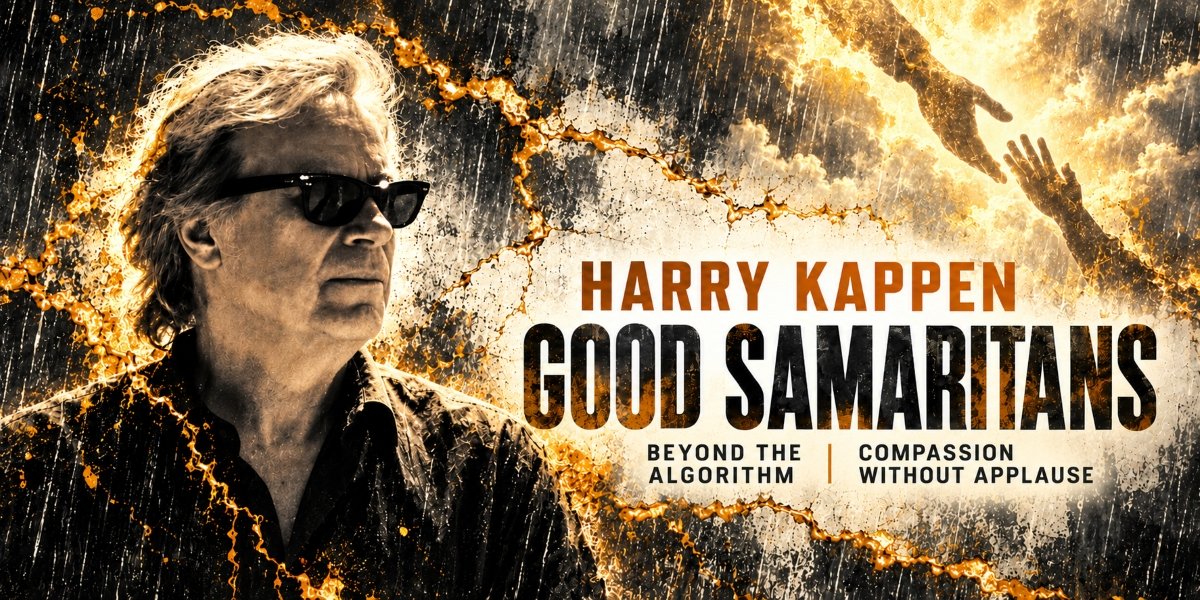
There is an old fantasy embedded in popular music: the artist as savior. Give him a guitar, a spotlight, and three minutes of amplified conviction, and perhaps he can shake the audience awake. Harry Kappen complicates that fantasy on “Good Samaritans,” an energetic rock single from his album After the Crossing. He invokes superheroes only to dismiss them, arguing that salvation is more likely to come from ordinary people whose acts of mercy never reach the screen.
Kappen’s premise is simple, but it opens onto a distinctly contemporary anxiety. Social media promised to connect humanity and instead handed each of us a mirror, a stage, and an unpaid position in our own publicity department. “Good Samaritans” surveys the resulting landscape: “flashy words,” filtered pain, “plastic smiles,” sculpted skies, and dreams sold with the assurance that purchasing them will make us whole.
This is more than another complaint about phones. Kappen is examining what happens when the vocabulary of advertising colonizes personal identity. We no longer merely buy products; we market ourselves as products, polishing our emotions into content and arranging our lives around favorable angles. Suffering becomes acceptable once it can be edited into inspiration. Happiness becomes compulsory because somebody else always appears to be having “the best time” imaginable.
Kappen captures the economic logic beneath that performance in one terse line: “Buy this dream and you’ll be whole.” The promise is designed to remain unfulfilled. Wholeness would end the transaction, and the system requires our permanent dissatisfaction.
Musically, “Good Samaritans” carries the firm momentum of a rock anthem, using energy as a vehicle for moral urgency. Kappen has identified David Bowie as an influence on this single and its predecessor, “Distant Shore.” That lineage is particularly meaningful here. Bowie understood identity as theatrical construction; a fluid, imaginative act that could liberate people from inherited roles. Kappen confronts the darker mutation of that possibility: identity rebuilt not for discovery, but for approval.
The distinction matters. Performance can be freedom, but it can also become confinement. When every gesture is made for an invisible audience, the private self begins to disappear. Kappen’s “there’s a war for every smile” describes the emotional violence of compulsory happiness, where joy is no longer an experience but a competitive display.
Into this spectacle he introduces the good Samaritan, an almost defiantly unfashionable figure. These people stand in the rain, stop to help, and share another person’s pain. They are unseen, “never trending,” and indifferent to recognition. Their compassion is valuable because it is directed toward someone else rather than reflected toward themselves.
Mexican singer Danna Gomez joins Kappen in the choruses, transforming his observation into something closer to a collective appeal. Her presence also reflects the cross-cultural chapter behind After the Crossing, Kappen’s first album recorded after moving from the Netherlands to Mexico. Kappen performed, sang, and produced all ten songs himself, yet Gomez’s voice prevents “Good Samaritans” from feeling like an isolated sermon. The chorus becomes communal because compassion, by definition, cannot be a solo performance.
Kappen’s background as a music therapist deepens the song’s argument. He spent more than two decades working in youth care and later taught in an international master’s program in music therapy. That experience suggests an intimate understanding of listening as labor. Real attention is not passive. It requires patience, vulnerability, and the willingness to remain in someone else’s difficult reality without converting it into a story about oneself.
“Simple hearts choose to stay / When the rest walk away,” Kappen sings. The word “simple” is crucial. He is not praising ignorance or innocence; he is stripping empathy of the elaborate excuses that prevent it. Somebody is hurting. Will you stay?
The song’s most memorable line, “These saints don’t wear capes,” closes the distance between myth and daily life. Kappen’s heroes possess no supernatural gifts. They cannot fly, reverse time, or defeat evil in a spectacular final battle. They can recognize another human being’s pain and respond to it.
“Good Samaritans” does not pretend individual kindness can resolve every political or structural injustice. Compassion alone cannot repair broken institutions or redistribute power. But no movement, community, or humane future can exist without the instinct Kappen celebrates: the recognition that another person’s suffering places some claim upon us.
In an era when visibility is routinely mistaken for value, Harry Kappen makes a persuasive argument for the unseen. “Good Samaritans” asks listeners to step away from the performance of humanity and return to its practice. The true hero, it suggests, is not the person who appears larger than life. It is the one who notices another life and refuses to walk away.