
Music Observer

Guitar Roots, Opera Spotlight, and Community Heart: The Collaborative Story of David Jesus Ybarra & Gabi Maldonado


David Jesus Ybarra and Gabrielle “Gabi” Maldonado represent a powerful creative partnership in Southern California’s vibrant theater and music scene. Together, they blend classical discipline, theatrical expertise, heartfelt songwriting, and a deep commitment to community, proving that music thrives when passion meets purpose.

Gabi Maldonado is an accomplished music director, performer, composer, educator, and USC alumna. Her credits include music directing major productions such as The Secret Garden (2023) and Little Women: The Broadway Musical (2022) at Chance Theater, where her piano accompaniment and leadership earned critical praise for elevating the storytelling and supporting the cast. She has also contributed to Carrie, multiple Chance Theater shows, and other regional productions, often praised for her actor-centered approach that prioritizes emotional truth and collaboration over technical perfection.

Photo Courtesy: David Ybarra

Beyond the podium, Gabi brings multifaceted talent to every project. She has performed on stage (including as Beggar Woman in Sweeney Todd), composed and arranged music, written lyrics, and taught at institutions like Fullerton College, where her professional experience inspires students with real-world insight. Her work consistently bridges the roles of musician, director, and mentor, helping actors discover deeper connections to their characters while creating cohesive, moving musical experiences.

David Jesus Ybarra, the creative force behind An Army of Flowers, complements Gabi’s theatrical expertise with his own distinctive background. A classically trained guitarist and multifaceted songwriter, David has built a career that spans original compositions, theater performance, and community impact. His breakthrough came as featured guitarist in a special orchestral production of Natasha, Pierre, and the Great Comet of 1812, where the rock-infused score allowed him to merge classical technique with dramatic storytelling. “As a songwriter stepping into opera for the first time, it was an experience I couldn’t pass up,” he recalls.

While balancing a full-time career in logistics, David finds deep fulfillment in music as both personal nourishment and a tool for growth. Through An Army of Flowers, he aspires to create a hub for youth enrichment, offering music-based programs that help young artists find their voices and develop into confident community leaders. His work carries a strong sense of heritage: “I don’t play just for personal legacy, but to prolong that of my ancestors,” he says, drawing primary inspiration from his grandfather’s values of perseverance and cultural pride.

Their paths converged through theater, where Gabi’s guidance as music director sharpened David’s theatrical instincts and fostered genuine collaborative magic. As one of the musicians under her leadership, David credits her expertise with helping him bridge his guitar roots and songwriting with the demands of staged musical storytelling. In turn, David’s versatile playing and original music perspective bring fresh energy to Gabi’s projects.

Together, Ybarra and Maldonado form a dynamic duo that inspires up-and-coming artists. They champion original music in theater and opera while actively nurturing the next generation, showing that it is possible (and deeply rewarding) to pursue artistic dreams alongside “real life.” Their shared vision emphasizes heritage, service, joy, and community connection. David’s small business aims to grow into a supportive space for youth, an ambition that aligns naturally with Gabi’s role as an educator and her focus on supporting performers.

Whether performing for causes close to their hearts, such as benefits supporting refugee minors or honoring labor leaders like United Farm Workers President Teresa Romero, or simply creating intimate, meaningful music, the pair weaves social consciousness into their art. David has also shared stages with artists like Aryanna Belémm Hernández, adding cross-cultural richness to their collaborative world.

In an industry often driven by trends, David Jesus Ybarra and Gabi Maldonado show that music’s true power lies in connection, to family roots, to community struggles, and especially to the young souls ready to bloom. Through their intertwined journeys, one rooted in classical guitar and ancestral legacy, the other in musical direction and theatrical elevation, they offer a compelling model for balancing passion with purpose.

Their story invites listeners, theater lovers, and aspiring musicians to join the army, one note, one lesson, one shared performance at a time.

An Army of Flowers on Instagram
An Army of Flowers on SoundCloud

David Jesus Ybarra on Spotify

An Army of Flowers on YouTube

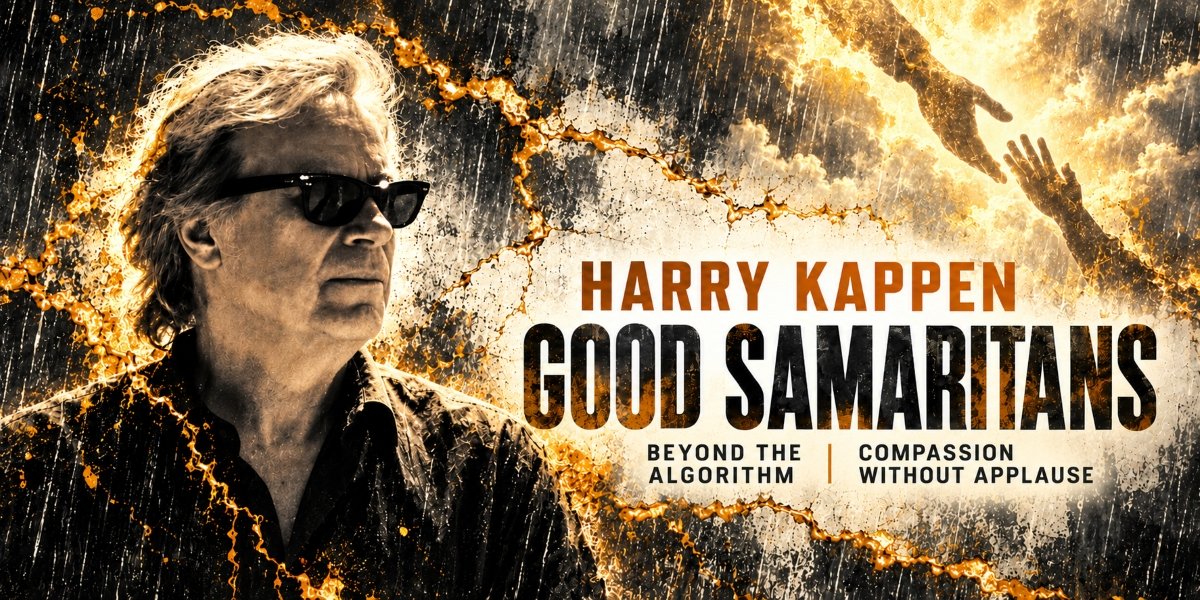
Harry Kappen Searches for Humanity Beyond the Algorithm on “Good Samaritans”

By Mike Lewis

There is an old fantasy embedded in popular music: the artist as savior. Give him a guitar, a spotlight, and three minutes of amplified conviction, and perhaps he can shake the audience awake. Harry Kappen complicates that fantasy on “Good Samaritans,” an energetic rock single from his album After the Crossing. He invokes superheroes only to dismiss them, arguing that salvation is more likely to come from ordinary people whose acts of mercy never reach the screen.

Kappen’s premise is simple, but it opens onto a distinctly contemporary anxiety. Social media promised to connect humanity and instead handed each of us a mirror, a stage, and an unpaid position in our own publicity department. “Good Samaritans” surveys the resulting landscape: “flashy words,” filtered pain, “plastic smiles,” sculpted skies, and dreams sold with the assurance that purchasing them will make us whole.

This is more than another complaint about phones. Kappen is examining what happens when the vocabulary of advertising colonizes personal identity. We no longer merely buy products; we market ourselves as products, polishing our emotions into content and arranging our lives around favorable angles. Suffering becomes acceptable once it can be edited into inspiration. Happiness becomes compulsory because somebody else always appears to be having “the best time” imaginable.

Kappen captures the economic logic beneath that performance in one terse line: “Buy this dream and you’ll be whole.” The promise is designed to remain unfulfilled. Wholeness would end the transaction, and the system requires our permanent dissatisfaction.

Musically, “Good Samaritans” carries the firm momentum of a rock anthem, using energy as a vehicle for moral urgency. Kappen has identified David Bowie as an influence on this single and its predecessor, “Distant Shore.” That lineage is particularly meaningful here. Bowie understood identity as theatrical construction; a fluid, imaginative act that could liberate people from inherited roles. Kappen confronts the darker mutation of that possibility: identity rebuilt not for discovery, but for approval.

The distinction matters. Performance can be freedom, but it can also become confinement. When every gesture is made for an invisible audience, the private self begins to disappear. Kappen’s “there’s a war for every smile” describes the emotional violence of compulsory happiness, where joy is no longer an experience but a competitive display.

Into this spectacle he introduces the good Samaritan, an almost defiantly unfashionable figure. These people stand in the rain, stop to help, and share another person’s pain. They are unseen, “never trending,” and indifferent to recognition. Their compassion is valuable because it is directed toward someone else rather than reflected toward themselves.

Mexican singer Danna Gomez joins Kappen in the choruses, transforming his observation into something closer to a collective appeal. Her presence also reflects the cross-cultural chapter behind After the Crossing, Kappen’s first album recorded after moving from the Netherlands to Mexico. Kappen performed, sang, and produced all ten songs himself, yet Gomez’s voice prevents “Good Samaritans” from feeling like an isolated sermon. The chorus becomes communal because compassion, by definition, cannot be a solo performance.

Kappen’s background as a music therapist deepens the song’s argument. He spent more than two decades working in youth care and later taught in an international master’s program in music therapy. That experience suggests an intimate understanding of listening as labor. Real attention is not passive. It requires patience, vulnerability, and the willingness to remain in someone else’s difficult reality without converting it into a story about oneself.

“Simple hearts choose to stay / When the rest walk away,” Kappen sings. The word “simple” is crucial. He is not praising ignorance or innocence; he is stripping empathy of the elaborate excuses that prevent it. Somebody is hurting. Will you stay?

The song’s most memorable line, “These saints don’t wear capes,” closes the distance between myth and daily life. Kappen’s heroes possess no supernatural gifts. They cannot fly, reverse time, or defeat evil in a spectacular final battle. They can recognize another human being’s pain and respond to it.

“Good Samaritans” does not pretend individual kindness can resolve every political or structural injustice. Compassion alone cannot repair broken institutions or redistribute power. But no movement, community, or humane future can exist without the instinct Kappen celebrates: the recognition that another person’s suffering places some claim upon us.

In an era when visibility is routinely mistaken for value, Harry Kappen makes a persuasive argument for the unseen. “Good Samaritans” asks listeners to step away from the performance of humanity and return to its practice. The true hero, it suggests, is not the person who appears larger than life. It is the one who notices another life and refuses to walk away.