By Johnny Rodriguez
There are few artists whose lives can be divided into such dramatically different chapters as Ananda Xenia Shakti’s. In one life, she was Xenia Holliday, a fearless young musician helping to define the late-1970s punk scene as a founding member of the B-Girls, performing alongside legendary artists such as The Clash and lending her voice to Blondie’s AutoAmerican. In another, she became a spiritual seeker, teacher, and creator of devotional music dedicated to healing, compassion, and the transformative power of love.
Yet, according to Ananda, those worlds are not nearly as far apart as they might seem.
“They are all in the pursuit of a fuller and deeper expression of one’s self, of freedom, of uniting, of breaking down boundaries to allow what is real to rise,” she explains. “By cultivating really high-powered energy and directing it toward the desire to go out of control, out of the control of conditioning, you discover the ecstatic self on the other side.”
That idea of liberation has been the central thread woven throughout her remarkable journey.
The B-Girls were among the pioneering all-female punk bands of their era, emerging at a time when musical conventions were being challenged and rewritten almost daily. Ananda was only eighteen years old when the group formed, and the experience would shape the way she viewed both art and life.
“It taught me that dreams do come true,” she says. “Dream, have fun first and foremost, and trust the dream. Life is magic.”
By conventional standards, the band was on the verge of enormous success. Opportunities were appearing, recognition was growing, and the future seemed to be opening in exciting new directions. Then everything changed.
Ananda experienced a profound spiritual awakening that altered the course of her life forever.
“I left the punk world when our band was at its height,” she recalls. “I found what I had been looking for. I knew that all of my seeking and searching through the punk days had led me to that moment.”
She understood instinctively that she couldn’t fully inhabit both worlds at once. To continue her journey, she would have to leave behind not only a successful musical career but also the temptations of fame and recognition.
“I needed to immerse myself fully in the new experience,” she says, “so that I wouldn’t fall back into older, familiar states of consciousness.”
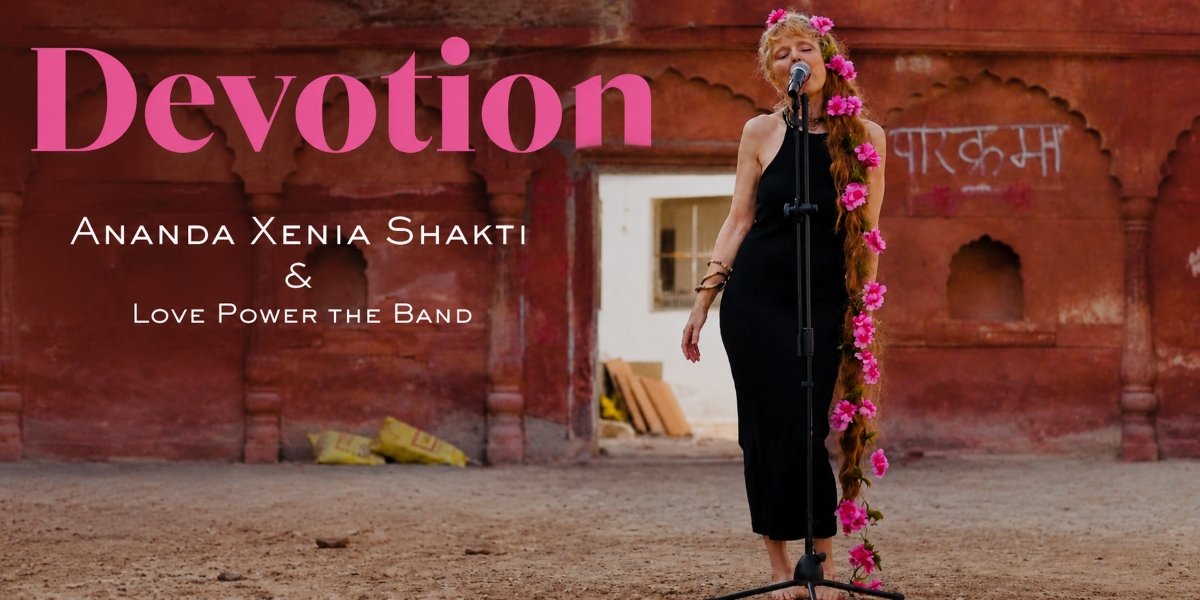
Today, that spiritual path finds expression through Love Power the Band and the release of her latest single, Devotion.
The song emerged during a silent meditation retreat in Andhra Pradesh, India. What began as an evening of physical discomfort gradually transformed into a profound spiritual experience. Unable to meditate in the traditional sense, Ananda began softly chanting and soon discovered that a melody was beginning to emerge.
“When I felt the song’s self-soothing quality, I decided right then that I was going to find a way to record it that would capture exactly what I was feeling in that moment.”
For Ananda, inspiration isn’t something that can be forced. It arrives naturally when the mind becomes quiet enough to receive it.
“Most music is inspired rather than linearly written,” she explains. “For me, much of that inspiration comes while communing with what I would call the angelic realm. I’m listening to a source frequency. It has an openness and a flow to it. It all arrives at once.”
That perspective shapes not only her music but her understanding of life itself. One of the most important lessons she learned came from her first spiritual mentor, who helped her realize that life’s challenges are not obstacles but invitations.
“I learned that every experience can bring us into a greater reality of love,” she says. “We are never victims of our lives. Life is always on our side. Creation is always on our side. It is always compelling us to become a greater and more complete version of ourselves.”
That philosophy lies at the heart of Devotion, which explores the idea that expansion often arises from contraction and that transformation can emerge from discomfort.
The mission of Love Power the Band extends far beyond music itself. Ananda hopes that listeners experience something much deeper than simple entertainment.
“I sincerely wish that Love Power the Band serves as an experience of remembering,” she says. “That people remember that they are love and that unity is truth.”
In a world often defined by conflict, division, and uncertainty, she believes music can become a form of medicine.
“It’s perfect medicine for our challenging times.”
As for the future, Ananda’s dreams remain as expansive as ever. She envisions creating a healing center that combines spirituality, music, and the fine arts to help people discover wisdom, beauty, joy, and a renewed sense of wholeness. She also hopes to build an online community where people can gather, learn, heal, and connect.
Above all, she hopes to continue sharing the message that has guided her extraordinary journey, from the raw energy of punk rock to the stillness of meditation halls and the sacred sounds of Devotion.
Her message is a simple one.
Remember the love that you are.