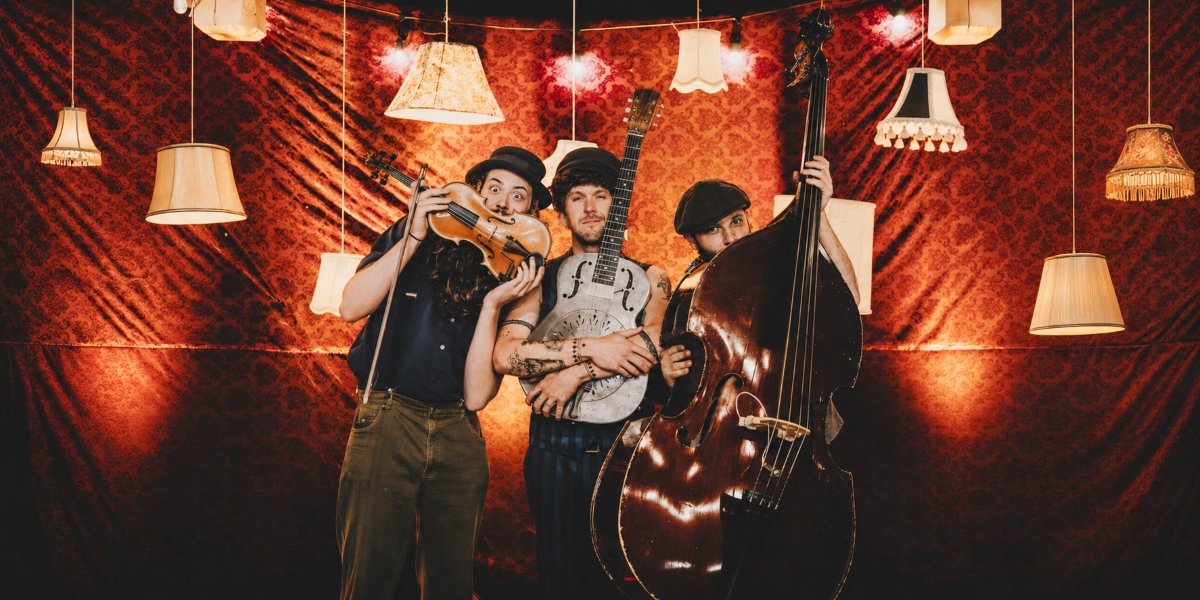
There’s something wonderfully unpredictable about Bosko Baker. The roots musician has spent years taking his music from street corners to festival stages, drawing on the sounds of traditional American music while developing a performance style that’s entirely his own. His release “Troubles” offers another opportunity to discover that world, appearing on his latest album, Bozo Broadcasting Presents An All Fools Double Half Hour Do Maker Radio Special.
It’s quite a title, but anyone familiar with Baker’s approach to music will know that he has never been particularly concerned with keeping things conventional.
Blending country blues, ragtime, folk and swing, Baker describes his musical style as “street swing” or “bozo blues.” His work draws inspiration from musicians such as Mississippi John Hurt, Blind Blake, Doc Watson and Merle Travis, bringing older musical traditions into his own growing catalog.
A large part of that identity comes from his experience as a street performer. Having spent considerable time between Quebec City and New Orleans, Baker has developed his craft in environments where connecting with an audience is just as important as the music itself. His performances have taken him across Canada, the United States, Europe, the United Kingdom and South America, introducing his distinctive approach to roots music to listeners from different backgrounds.
That experience has helped shape an artist whose music feels closely connected to the traditions that inspired it. With “Troubles,” listeners are introduced to a song that occupies an interesting place within his latest project.
Rather than appearing just once, the track features in three different forms across the album. Alongside the main version, listeners will find “Troubles (Solo)” and “Troubles (Birdie Special),” offering several opportunities to explore the same piece within the wider release.
It’s an unusual detail that fits comfortably with Baker’s willingness to approach music on his own terms.
The album itself arrived on October 23, 2026, featuring 28 tracks across just over an hour of material. Songs including “Puddle of Joy,” “Back Then, Back When,” “Good Ships, Wood Ships” and “With Friends Like These” sit alongside shorter contributions involving All Fools Radio.
Together, the tracklist suggests a project interested in presenting more than a straightforward collection of songs, with its radio-special framing adding another element to the listening experience.
For those discovering Baker through “Troubles,” there’s also an extensive back catalog worth exploring.
His earlier releases include Fixin’ To Grow, The Magnolia Sessions and Mr. Brown & Mr. Blue Volume Two, alongside songs such as “Business for the Business Man” and “Montreal Mess Around.”
Across these projects, Baker has continued to celebrate the musical traditions that originally inspired him, while building a reputation through his energetic live performances and fingerpicking guitar style.
It’s that combination of experience and individuality that makes his latest material worth exploring. At a time when so much contemporary music is built around polished production and familiar formulas, Baker’s commitment to roots music offers listeners a connection to a different musical tradition.
“Troubles” provides another entry point into that catalog, while the album surrounding it demonstrates just how much material Baker has brought together for this latest release.
And whether listeners are already familiar with his music or discovering him for the first time, there’s plenty to explore in the wonderfully unconventional world of Bosko Baker.
https://open.spotify.com/track/3zbSjd3Co1zqq7rX1NNyNR?si=35bc0ea34d2e46a6