By: Sarah Whitmore
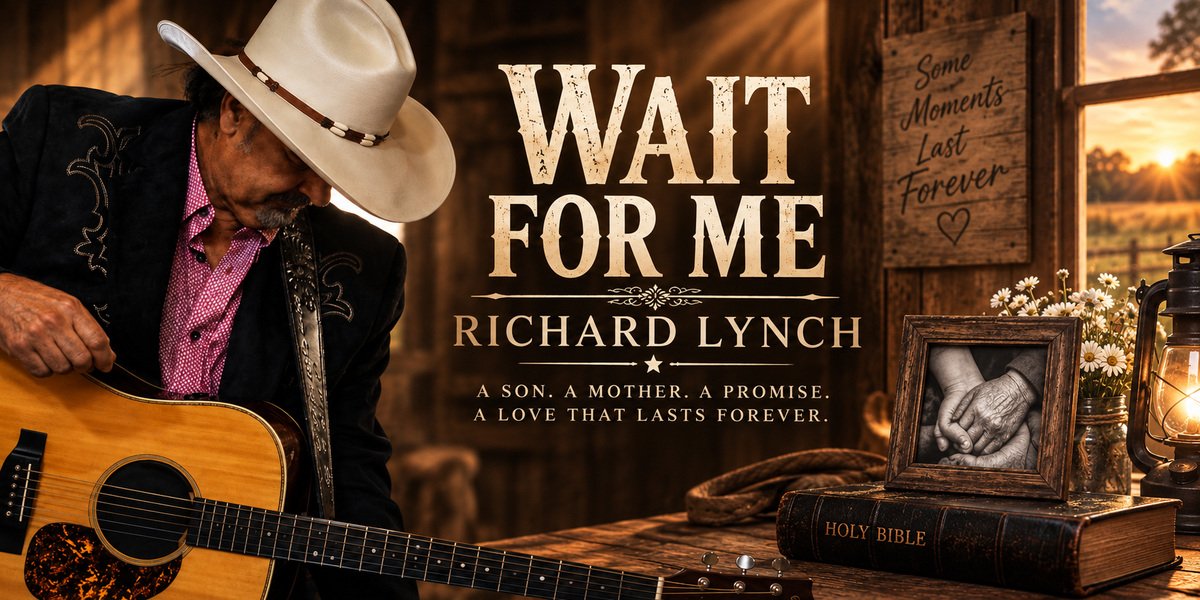
Country music has long made monuments out of ordinary things. A kitchen table, an old photograph, a weathered house, or a stretch of highway can become a repository for entire lives. On “Wait For Me,” Richard Lynch finds that kind of history in something even more elemental: his mother’s hands.
The Ohio traditionalist’s deeply personal single, co-written with John Lee, begins at a bedside. Lynch has come to visit his mother and finds her asleep. He stays, takes her hands, and begins to cry. But from the outset, “Wait For Me” complicates what could easily become a conventional song of mourning. His tears, he explains, aren’t simply those of grief. They come from “thankfulness and joy.”
He is looking at the present and remembering the past at exactly the same time.
Holding his mother’s hands transports Lynch back to childhood, when those hands belonged to someone who seemed capable of fixing whatever the world might break. They wiped away tears and soothed pain. They stitched clothing. They performed the thousand small tasks that rarely enter family histories because, at the time, nobody thinks to write them down.
Lynch writes them down.
It’s the song’s smartest decision.
Country music has always been preoccupied with memory, but its best writers understand that nostalgia becomes meaningful through specificity. Saying your mother sacrificed everything is sentiment. Remembering her hands sewing your clothes makes the sacrifice visible.
Lynch pushes that image further when he sings of those hands having “moved mountains.” The phrase could have tipped into cliché. Instead, surrounded by all those smaller acts, it feels like the natural conclusion of a child finally understanding what adulthood has taught him about his mother.
What seemed ordinary was enormous.
That realization arrives because time is running out.
Lynch receives word that his mother is ready “to leave with God.” She has made peace with what is coming. She has always believed.
Her son has one request.
“Momma, I’m on my way.”
Then: “Hold on, wait for me.”
There is no elaborate poetry in the line, and there shouldn’t be. People confronted with the possible death of someone they love rarely become poets. The world shrinks. Language does too.
Wait.
That single word contains the urgency of a lifetime.
Lynch has spent much of his career occupying territory increasingly uncommon in contemporary country: not merely traditional instrumentation or cowboy aesthetics, but an older conception of what a country singer is supposed to do. The singer is the vessel for the story. Technique matters, but credibility matters more. The performance works when listeners believe the person singing understands what the words mean.
“Wait For Me” depends on that credibility.
Lynch’s mature voice gives the song a perspective unavailable to a younger singer. This isn’t someone imagining that parents eventually become old. It is a narrator confronting the reversal that waits inside every fortunate childhood: the people who cared for us will someday need care themselves.
The third verse brings that reversal into focus.
“If your hands are tired now,” Lynch sings, before wondering whether they ache because of everything they have done for others.
The boy who once needed those hands is now holding them.
And he hopes that, somehow, his presence might return a fraction of what he received.
“Maybe I gave you a little comfort back,” he reflects, “in some small way.”
That “small” is important. Lynch doesn’t pretend the scales can ever be balanced. How does someone repay decades of parenthood in one bedside visit?
You can’t.
You can only show up.
Faith provides the song with its larger framework without erasing its human uncertainty. Lynch believes his mother is going to God, but belief doesn’t make the drive less urgent. Heaven may promise reunion; the son still wants one more earthly goodbye.
That tension has sustained gospel and country music for generations. Faith offers hope, but faith does not necessarily eliminate grief. Often the two occupy the same song, sometimes the same line.
By the ending, the desperate request contained in the title has been answered.
His mother’s pain is gone. She can rest.
Most importantly, she waited.
“You were able to see / Just how much I love you,” Lynch sings. “You held on / You waited for me.”
The resolution is almost painfully modest. There is no miracle in the conventional sense. The mother does not recover. Time does not reverse itself.
The miracle is that the son arrives before it is too late.
In another era, a song like “Wait For Me” would have seemed entirely unsurprising within mainstream country music. Songs about parents, mortality, work and faith once occupied substantial territory on country radio. Today, its straightforwardness can almost feel countercultural.
Lynch isn’t attempting to reinvent the form. He is preserving one of its oldest functions: documenting ordinary lives before they disappear.
And that brings us back to those hands.
They are the real archive here. Every wrinkle represents work performed without applause, every ache evidence of something carried for somebody else.
Eventually, all children who are lucky enough to grow older discover that their parents had histories beyond them, that Mom and Dad were mortal people whose strength required effort.
Sometimes that realization arrives gradually.
Sometimes it arrives while sitting beside a bed, holding the hands that once held yours.
Richard Lynch’s “Wait For Me” understands the terrible beauty of recognizing that truth while there is still just enough time to say thank you.