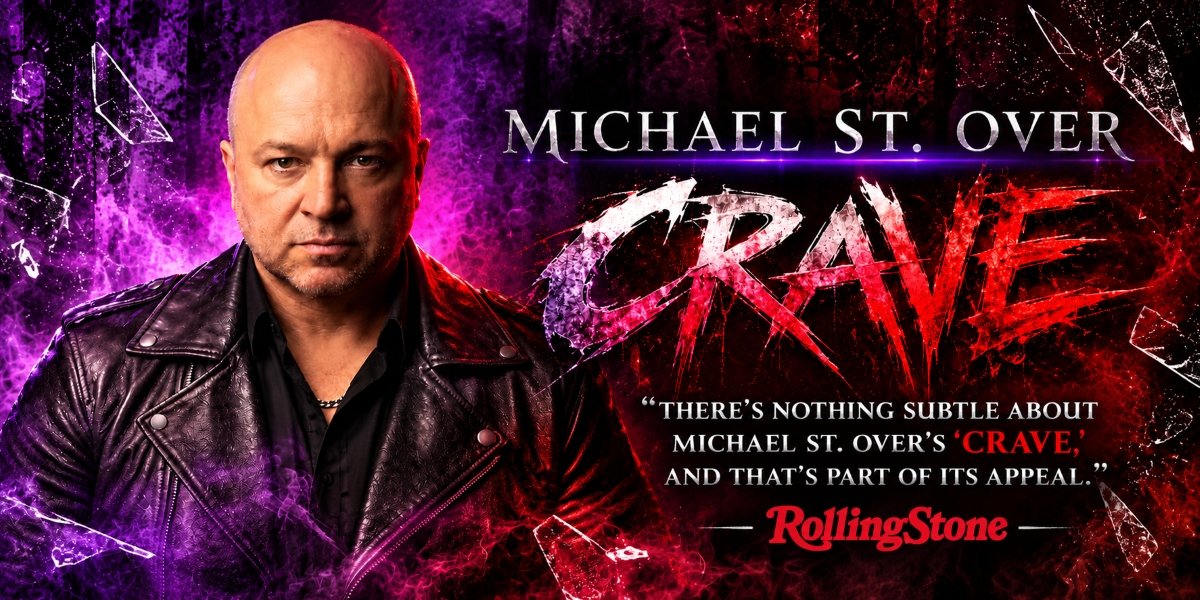
By: Danny Marks
There’s nothing subtle about Michael St. Over’s “Crave,” and that’s part of its appeal.
The single comes on like a confession made at full volume, built around one of rock’s oldest and most durable ideas: desire as a force strong enough to knock reason sideways. St. Over doesn’t treat attraction as flirtation. He treats it as compulsion. The title says as much. “Crave” is less about wanting someone than about reaching the point where wanting becomes need, and the song’s hard-rock framework gives that escalation exactly the kind of pressure it requires.
From the opening lines, St. Over makes his intentions plain. “I was born to love you baby / You were born to drive me crazy” is not a lyric designed to impress a poetry seminar. It is designed to land immediately, and it does. The song speaks in a language that belongs to jukeboxes, sweaty clubs, late-night drives, and every bad decision that sounded better once the guitars kicked in.
The central metaphor, love as a drug, is hardly new, but St. Over’s commitment keeps it from feeling disposable. He leans into the language of dependency, framing attraction as something habit-forming, destabilizing, and almost physically necessary. When he gets to the idea of another person’s love as the fix he keeps chasing, the song’s emotional logic is already locked in place.
That logic is reinforced by the arrangement. “Crave” is built for impact, not atmosphere. The guitars are thick, direct, and aggressively forward in the mix, while the rhythm section gives the track a steady sense of momentum. There’s enough polish to keep the record radio-ready, but not so much that it loses the rough-edged character the song depends on. The production understands the difference between clean and sterile.
That distinction matters.
A song like “Crave” falls apart if it sounds too careful. Its whole appeal comes from emotional overcommitment. St. Over sings as if restraint has already failed, and the performance benefits from that. There is no ironic distance in the vocal, no suggestion that he is embarrassed by the size of the feeling. He means it, or at least he performs as if he means it, which in rock music has always been the more important test.
The chorus is where the song earns its keep. It is blunt, repetitive, and immediate, built to stay in the listener’s head after one pass. That is not faint praise. Hooks this obvious can sound lazy when they are underwritten, but here the repetition mirrors the subject itself. Craving repeats. Obsession loops. Wanting rarely gets more articulate simply because it gets more intense.
There is also a useful contradiction at the heart of the track. On the surface, “Crave” is swaggering and physical. Underneath, it is about powerlessness.
That tension gives the single more depth than its big chorus initially suggests. The narrator may be projecting confidence, but the language tells another story. He is not in control of the desire he is describing. He is being dragged by it. That makes “Crave” more interesting than a standard conquest song because the real subject is not possession. It is surrender.
That idea fits naturally within St. Over’s larger musical identity, which has often emphasized struggle, redemption, and the costs of emotional extremes. Here, though, those concerns are stripped of spiritual framing and redirected into something darker and more sensual. “Crave” is not interested in salvation. It is interested in the moment before consequences arrive.
And that may be the song’s strongest quality.
It doesn’t try to explain itself away.
In an era when plenty of rock is either aggressively self-conscious or polished into personality-free product, “Crave” feels refreshingly committed to old-school instincts: big guitars, a big hook, an oversized emotional premise, and a singer willing to stand inside the feeling without pretending he is above it.
No, the song does not reinvent the genre. It is not trying to.
What it does instead is remind you why the basic machinery still works. Distortion still sounds good when the emotion underneath it is credible. A chorus still matters. A familiar metaphor can still hit when delivered with conviction.
Michael St. Over’s “Crave” understands all of that.
It is loud, direct, obsessive, slightly dangerous, and fully aware that some feelings do not become clearer when examined.
Sometimes they just get louder.