When it comes to live music, there are venues where the experience starts long before the first note plays. Places where the venues themselves are as legendary as the musicians who grace their stages. Ryman Auditorium devotees cite history and acoustics. MSG loyalists point to cultural weight. Hollywood Bowl fans argue scale, prestige, and the draw of a major city. And yet one venue keeps rising to the center of the debate. Red Rocks Amphitheatre, located approximately 10 miles southwest of Denver in Morrison, Colorado, occupies a category that other venues struggle to define, let alone challenge.
The question is not whether Red Rocks Amphitheatre is famous. The question is whether anything else in the country genuinely compares.
The Formation Behind the Fame
Red Rocks is the only naturally formed amphitheater of its kind used as a major concert venue in the world. The site sits between two massive sandstone formations, Ship Rock and Creation Rock, both approximately 300 million years old. The geology does the architectural work that designers spend entire careers trying to achieve with materials and budgets.
The venue holds around 9,500 people. That number is intentional in its significance. It is large enough to generate the shared energy of a major live performance and small enough that no seat feels disconnected from the stage. The altitude sits at 6,450 feet above sea level. The open Colorado sky above the audience creates a sensory environment that indoor venues and traditional outdoor amphitheaters simply cannot replicate.
Artists across every genre have performed here. Rock, electronic, classical, country, hip-hop, and jazz all translate into the natural formation. Playing Red Rocks is considered a career milestone across the music industry. It is not simply another tour stop on a routing sheet. For many artists, it represents a specific kind of arrival.
The Case for Other Venues

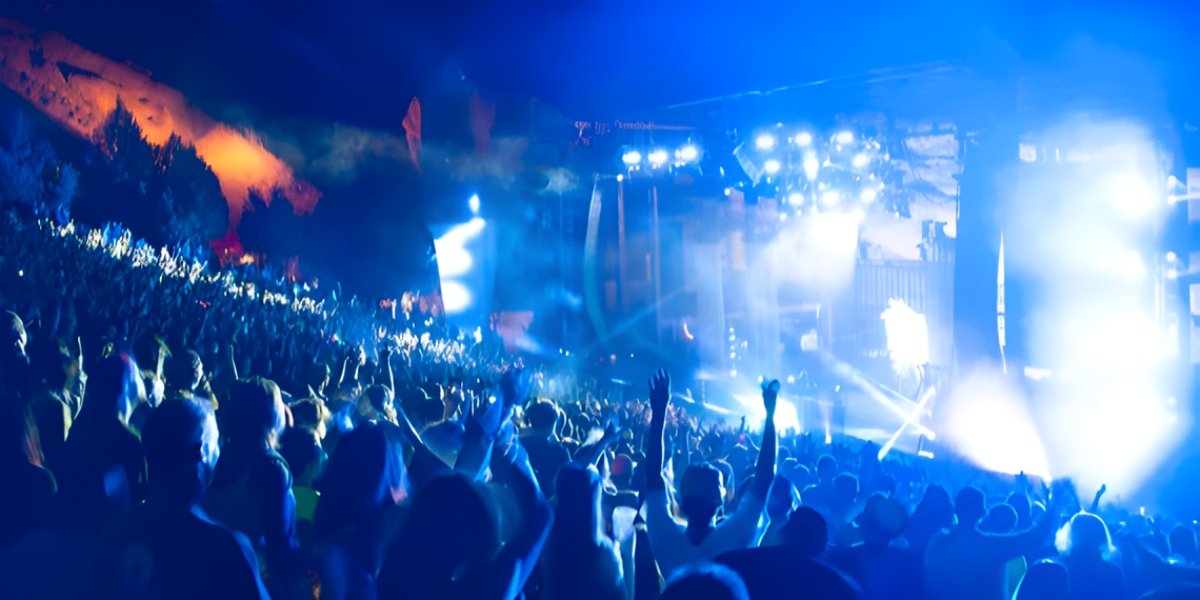
Photo Courtesy: Glenn Ross Photo (Janelle Monae performing at Red Rocks Amphitheatre)
A fair assessment requires honesty about the competition. Red Rocks has credible rivals, and it carries a real limitation that deserves direct acknowledgment.
The Gorge Amphitheatre in George, Washington, sits above the Columbia River Gorge and offers natural drama that matches or rivals any outdoor setting in the country. Ryman Auditorium in Nashville holds a music history that no other American venue can match. Its acoustics have been studied by sound engineers for decades, and its place in the story of American music is singular. Madison Square Garden remains the cultural standard for what it means to have made it as a performer. The Hollywood Bowl brings institutional prestige, a world-class orchestra residency, and the gravitational pull of Los Angeles.
Red Rocks also has a structural limitation worth stating clearly. The venue has no roof. Colorado weather is unpredictable, and sudden storms mid-show have become part of the venue’s mythology. That mythology is real and earned. But it is also a genuine scheduling and reliability factor that other major venues do not face. Weather cancellations and lightning delays are part of the Red Rocks experience in a way that they are not at MSG or Ryman.
What No Other Venue Can Replicate
Other venues may earn higher marks for acoustics, history, or cultural status. Red Rocks wins on the basis of the full sensory and visual experience of a live performance.
The natural light shifts throughout a show. As the sun drops behind the Colorado horizon, the sandstone faces change color in real time. The crowd is framed against the open sky. The rock formations are not a backdrop. They are part of the performance itself, and no stage design, lighting rig, or architectural feature built by human hands can manufacture that. Audiences arrive before the artist takes the stage, specifically to watch the sky change over the rocks.
That quality is what separates Red Rocks from every other venue in the country. It is not a building you walk into. It is a landscape where you watch a show.
A Photographer’s Perspective
Few people have a closer working relationship with what makes Red Rocks visually singular than the photographers who document it professionally. Red Rocks Photographer Glenn Ross, owner of Glenn Ross Photo, has photographed countless performances at the venue. His work spans live music, brand content, and cultural documentation across the Denver creative community.
Ross puts the experience plainly. “Red Rocks isn’t really a venue. It’s an experience that happens to include a stage. People have been gathering at those formations for millennia. The rocks predate everything we’ve built around them by hundreds of millions of years. There’s an energy there that you can’t manufacture or replicate.”
That observation is not sentimental. It reflects something that audience data, artist demand, and consistent industry recognition all confirm. Red Rocks Amphitheatre draws performers and visitors who travel specifically for the setting, independent of any single artist on the bill.
The Verdict
No single venue in America does everything. Ryman Auditorium has deeper historical roots. Madison Square Garden carries greater cultural symbolism. The Gorge offers natural drama on a comparable scale. The Hollywood Bowl brings institutional weight and urban prestige. Each makes a legitimate case.
What separates Red Rocks is a geological formation that existed for 300 million years before a single stage, seat, or sound system was placed inside it. That formation is not an amenity. It is the show. Every artist who performs there performs within something that cannot be constructed, purchased, or moved to another city.
Other venues are places you attend. Red Rocks is a place you experience.