By: Jean Apache
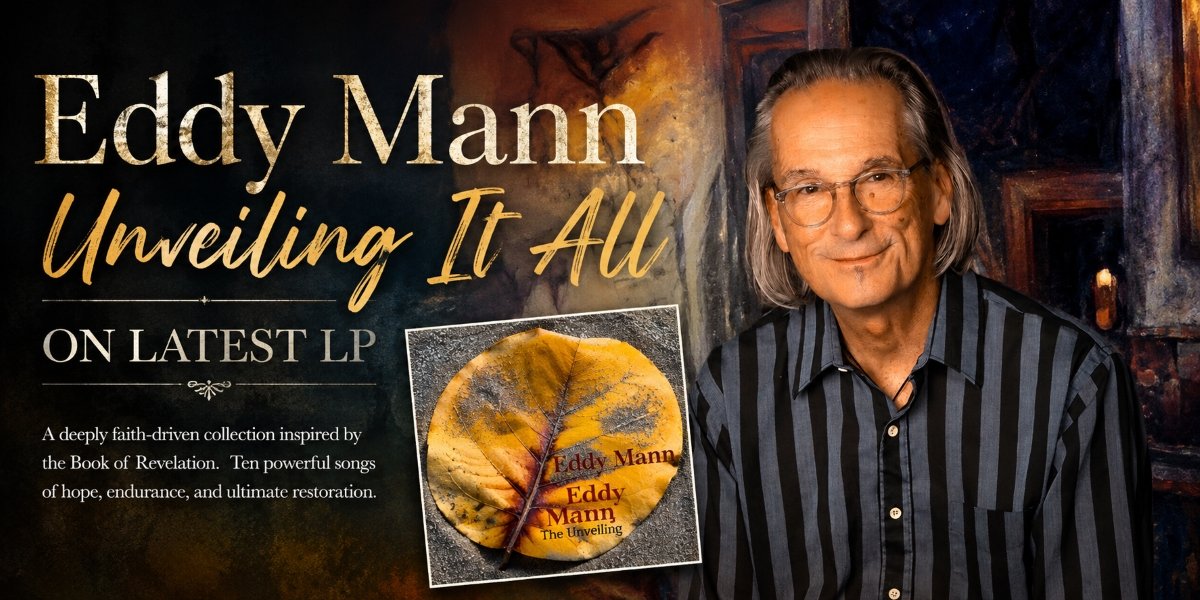
Some albums are designed to entertain. Others are created to inspire. Every so often, however, a record comes along that feels more like an invitation, an invitation to pause, reflect, and examine one’s faith through fresh eyes. Eddy Mann’s The Unveiling belongs firmly in that rare category.
Inspired entirely by the Book of Revelation, this ten-song collection could easily have become an exercise in dramatic prophecy or apocalyptic imagery. Instead, Mann delivers something far more compelling: a thoughtful, deeply personal exploration of God’s sovereignty, Christ’s promises, and the enduring hope found in Scripture’s final chapter.
That approach has long defined Mann’s work. Throughout his career, he has quietly established himself in Christian music as a singer-songwriter who emphasizes substance over spectacle. His music has never relied on elaborate production or contemporary trends to make its impact. Instead, it succeeds because of its honesty, careful songwriting, and unwavering commitment to biblical truth.
The Unveiling may very well be the culmination of that artistic philosophy.
Written over the course of three years after an extraordinary burst of creativity in early 2023, the album feels remarkably cohesive. Every song serves the larger narrative without sacrificing its own identity, creating a listening experience that unfolds chapter by chapter rather than simply track by track.
The opening selection, “I’m Coming (Remix),” immediately establishes the record’s emotional center. Drawing inspiration from Revelation 2, Mann reminds listeners that God’s complete knowledge of our lives is not meant to inspire fear but confidence. The repeated refrain, “Hold on tightly, I’m coming,” becomes less a warning than a promise, a recurring assurance that Christ remains faithful regardless of earthly uncertainty.
That sense of intimate devotion continues in “Oh That I’d Walk with You,” one of the album’s most moving performances. Built upon a simple lyrical framework, the song expresses the timeless desire to walk faithfully with God. Mann wisely resists overcomplicating the arrangement, allowing repetition to become meditation rather than redundancy.
“The Key of Love” demonstrates another of Mann’s greatest strengths as a songwriter: his ability to communicate profound theological concepts through remarkably accessible language. The progression from love to hope to trust unfolds naturally, revealing biblical truth without sounding instructional. It is songwriting that teaches by invitation rather than declaration.
The worshipful centerpiece arrives with “We Are” and “Worthy.” These songs draw directly from Revelation’s heavenly throne room, yet they never lose their humanity. Mann’s vocals remain conversational, allowing listeners to feel included rather than merely observing the scene from a distance. The result is worship that feels personal before it becomes corporate.
Perhaps the album’s boldest moment arrives with “I Heard, I Saw, And I Watched.” Revelation’s visions of conquest, war, famine, death, and martyrdom are presented with remarkable restraint. Rather than emphasizing fear, Mann allows the stark repetition of the words themselves to carry their emotional weight. The song’s simplicity ultimately proves more effective than dramatic musical embellishment could have been.
One of the album’s undeniable highlights is “I Will Never Know the Desert Again.” Inspired by Revelation’s promise that God’s people will hunger and thirst no more, the song radiates peace. Mann’s gentle vocal delivery perfectly complements lyrics that offer comfort without sentimentality. It is the emotional heart of The Unveiling, reminding listeners that Revelation ultimately points toward restoration rather than destruction.
“The Fall” shifts attention to Babylon’s collapse with poetic imagery that reflects both sorrow and inevitability. Mann captures the weight of worldly systems giving way before God’s eternal kingdom without descending into triumphalism. It is a thoughtful reminder that biblical justice carries both consequence and hope.
Closing with “Where the Gates Never Close” and “Hallelujah (Remix),” the album reaches its natural destination. These songs celebrate the New Jerusalem and eternal worship with quiet confidence rather than exuberant excess. They leave listeners with a profound sense of peace, a fitting conclusion to an album rooted in faith’s ultimate promise.
What makes The Unveiling so memorable is its authenticity. Eddy Mann never attempts to simplify Revelation’s mysteries, nor does he sensationalize them. Instead, he approaches Scripture with humility, allowing the songs to become reflections rather than explanations.
In today’s musical landscape, where volume often substitutes for depth, The Unveiling stands apart because it trusts both God’s Word and the listener. Eddy Mann has created more than an album; he has crafted a devotional journey that invites repeated listening, careful contemplation, and renewed hope.
That is a rare accomplishment, and perhaps his finest work to date.