By: Jonathan Mercer
On a song written with her 98-year-old father, the Pittsburgh singer-songwriter turns American history into a meditation on heroism, lost innocence, and the complicated business of believing in a country.
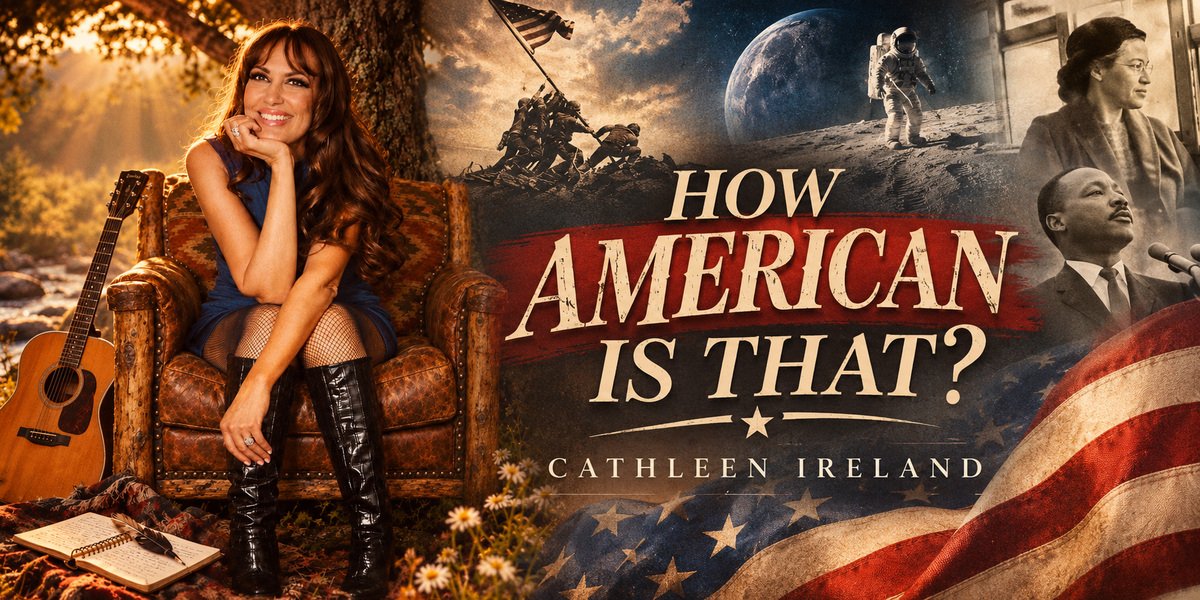
There is a photograph of a little boy standing beside his mother, saluting a coffin. There is another photograph of six men raising a flag on a distant Pacific island. And there is a grainy television transmission of an astronaut stepping onto the surface of the moon, his words traveling across nearly a quarter-million miles of emptiness before reaching a country that, for a few extraordinary moments, stopped whatever it was doing to listen.
These are American images. They belong to history, but they also belong to the strange national mythology that exists somewhere between what actually happened and what people need to believe happened.
Cathleen Ireland has made a song out of them.
“How American Is That?”, released November 6th as part of her acoustic album Roots & Wings, seems at first to be a straightforward patriotic celebration. Its chorus asks listeners to remove their hats, place them over their hearts, and give thanks for the country that produced these extraordinary moments.
But beneath that familiar sentiment lies something more interesting: a collection of American ghosts, summoned by a 98-year-old man who has lived long enough to remember when some of these events were not history at all.
Ireland’s father conceived the song during sleepless nights following the death of his wife. He would lie awake remembering the moon landing, the flag at Iwo Jima, and John F. Kennedy Jr.’s heartbreaking salute during his father’s funeral. He brought these images to his daughter, who helped shape them into lyrics and contributed the song’s bridge.
The collaboration is central to the recording’s meaning.
An elderly man reaches backward through his memories. His daughter turns those memories into music. What emerges is not simply a celebration of America but an attempt to preserve a version of it before time carries it away.
The opening reference to Neil Armstrong and Buzz Aldrin recalls an era when American ambition seemed capable of transcending ordinary human limitations. The astronauts were technological pioneers, certainly, but they were also characters in an almost biblical drama: human beings leaving the earth, entering the heavens, and returning with proof that the impossible had become possible.
Then Ireland introduces Ira Hayes.
Hayes, the Native American Marine immortalized in the Iwo Jima flag-raising photograph, belongs to a different American tradition. His story contains the contradiction between national glory and personal suffering, between a country celebrating a man as a hero and failing to fully recognize the humanity of the people from whom he came.
His presence complicates the song, perhaps more than its celebratory framework intends.
And then there is John-John Kennedy.
That salute remains one of the most devastating images in American public life. A child too young to comprehend the political meaning of his father’s death performs a gesture that an entire nation interprets as an expression of dignity.
Ireland’s song turns that moment into another answer to its central question: How American is that?
But the question becomes increasingly difficult to answer.
What exactly makes something American? The moon landing? The flag? A child’s grief? A woman refusing to surrender her seat on a segregated bus?
The bridge offers a fascinating assortment of figures: Captain Sully Sullenberger, Jonas Salk, David Ho, Rosa Parks, and Martin Luther King Jr.
These people did not share a single ideology or mission. Some worked within established institutions. Others challenged those institutions because they were unjust. Their achievements were sometimes celebrated immediately and sometimes resisted by the very society they sought to improve.
Yet Ireland places them together, suggesting that American identity might be found less in agreement than in the extraordinary things individuals accomplish when they refuse to accept the limitations of their circumstances.
The song’s acoustic character suits this kind of storytelling. Its emphasis on lyrics and a recurring, easily remembered refrain places it within a broad tradition of American narrative songwriting, where the names of historical figures can carry entire stories in just a few words.
Still, “How American Is That?” is not a protest song. It does not interrogate its heroes with the severity of a historical investigation. Its instinct is to celebrate, to gather seemingly disparate moments into a single emotional argument.
That approach has limitations. Nostalgia can transform a complicated national past into a comforting picture in which contradictions disappear beneath familiar symbols.
But there’s also an undeniable humanity in Ireland’s intentions.
She has explained that she and her father deliberately looked backward toward moments they associated with greater national unity. Their hope was to create something that might bring Americans closer together.
Whether those earlier decades were genuinely more unified is another question entirely. History suggests otherwise. But the longing itself is real, and it gives the song its emotional force.
The accompanying lyric video, directed by Michael Stover, reinforces that nostalgic perspective.
What finally distinguishes “How American Is That?” is not its patriotic declaration but the circumstances of its creation. A father nearing the end of a long life shares what he remembers. His daughter transforms those memories into a recording that may someday become part of someone else’s recollections.
In that sense, the song belongs to the deeper themes of Roots & Wings, an album spanning recordings from 1998 through 2026.
It is about inheritance, about what passes between generations, and about the stories people choose to preserve.
The record’s most revealing question may not be whether these historical moments were American.
It may be why this particular father needed his daughter to remember them.
And perhaps the answer is that a nation, like a family, exists partly through the stories it tells about itself. Some stories reassure. Others disturb. The important ones refuse to disappear.
Cathleen Ireland’s “How American Is That?” is not a definitive portrait of America. It is something smaller, more fragile, and arguably more moving: a daughter listening to her father describe the country he remembers, then singing those memories into the future.
For a song concerned with history, that may be its most enduring achievement.