By: Dr. Yuting Zhou
From contemporary Chinese piano music to Schumann’s Romantic masterpiece, Wang earned First Prize in both the preliminary and final rounds of an international music competition.
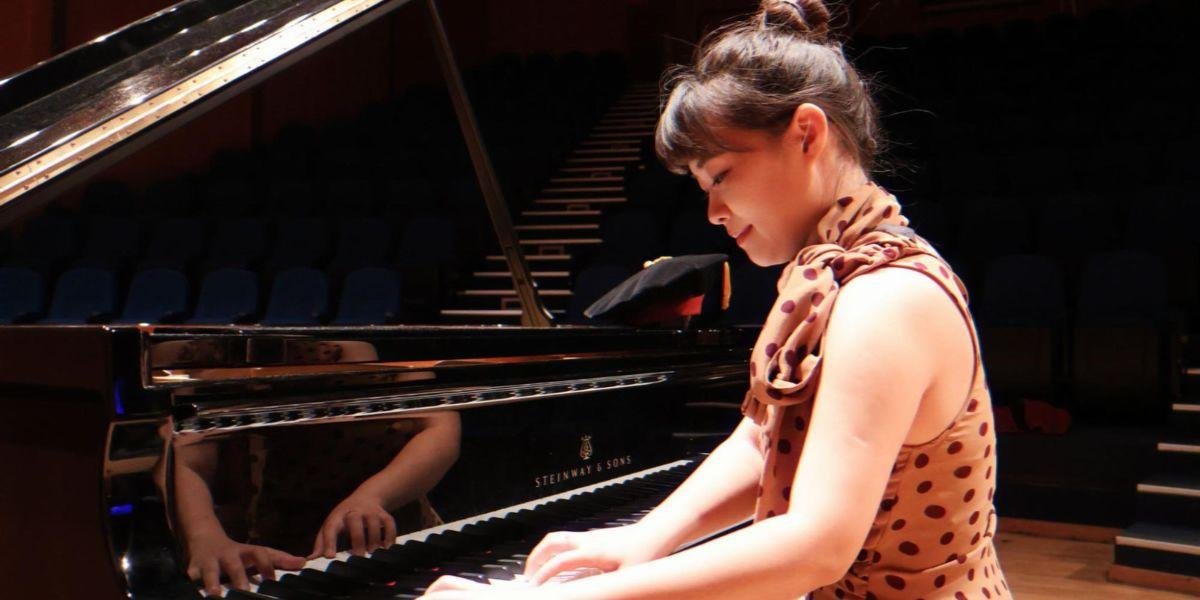
In late October 2026, pianist Lujie Wang received First Prize in the Piano Category at the Global Online Finals of the 2026 Sound of Music Australian International Music Competition, marking a significant milestone in her artistic career. The achievement followed her earlier First Prize recognition in the competition’s Global Online Preliminary Round, completing a competition journey distinguished by success in both stages.
Wang’s performances featured two contrasting works: Three Preludes by Chinese composer Zhang Shuai in the preliminary round and Robert Schumann’s Carnaval, Op. 9 in the finals. Representing different musical eras and traditions, the selections showcased her artistic versatility, interpretive sensitivity, and ability to navigate diverse musical styles.
For Wang, whose musical development has been shaped by rigorous training in both China and the United States, the achievement reflects years of dedication to piano performance and a continuing exploration of musical expression across cultural boundaries.
From Zhang Shuai to Schumann: Two Distinct Artistic Challenges
Wang’s competition journey began with Zhang Shuai’s Three Preludes, a contemporary Chinese piano composition that presents a musical language distinct from the traditional European classical repertoire. The work explores contrasts in rhythm, texture, and musical character, requiring the pianist to balance technical precision with expressive imagination. Its contemporary musical vocabulary calls for careful attention to articulation, tonal color, and the relationship between contrasting musical ideas. Through her preliminary-round performance, Wang introduced a contemporary Chinese work to an international competitive setting, demonstrating an interest in repertoire that reflects different cultural and artistic perspectives. Her performance earned First Prize in the Piano Category of the Global Online Preliminary Round and secured her advancement to the Global Online Finals.
For the final round, Wang selected Robert Schumann’s Carnaval, Op. 9, a landmark of nineteenth-century Romantic piano literature and one of the composer’s most imaginative works. Composed as a series of interconnected character pieces, Carnaval presents a vivid collection of musical personalities, emotional contrasts, and dramatic transformations. Its movements shift between lyrical introspection, playful elegance, passionate intensity, and virtuosic brilliance. Performing the work requires more than technical fluency. Each movement possesses its own musical identity, demanding precise characterization, refined tonal control, and a nuanced understanding of Romantic expression. At the same time, the pianist must maintain a coherent musical narrative throughout the larger cycle.
The contrast between the two rounds offered Wang opportunities to demonstrate different dimensions of her artistry. While Zhang Shuai’s Three Preludes emphasized the interpretation of contemporary musical language, Schumann’s Carnaval called for psychological depth, poetic imagination, and the ability to communicate a wide range of musical characters. Her First Prize distinction in the Global Online Finals crowned a competition experience that brought together two contrasting musical traditions through the expressive possibilities of the piano.
Shaping an Artistic Identity
Wang’s achievements are rooted in years of intensive musical training and a strong dedication to solo piano performance. She recently earned her Doctor of Music in Piano Performance in 2025, where she further refined her technical mastery, interpretive depth, and artistic individuality. As an active solo pianist, Wang has presented solo recitals in both China and the United States, performing in university and public concert settings. Her repertoire spans diverse musical periods and styles, reflecting her commitment to exploring the expressive possibilities of the piano. Through these performances, she has continued to develop her artistic voice, characterized by stylistic versatility, expressive sensitivity, and thoughtful musical interpretation.
Alongside her solo performance career, Wang has pursued graduate studies specializing in Collaborative Piano, expanding her musical perspective through instrumental and vocal collaboration. Her performance experience also includes appearances with the Symphony Orchestra and Wind Orchestra, further enriching her musical understanding and versatility. This combination of advanced musical training and international solo performance experience has played an important role in shaping Wang’s artistic identity. Her ability to navigate contrasting musical styles is reflected in her recent competition success, where performances of Zhang Shuai’s Three Preludes and Schumann’s Carnaval earned her First Prize distinctions in both the preliminary and final rounds.
First Prize Recognition and International Artistic Development
Receiving First Prize in both the preliminary and final rounds of the 2026 Sound of Music Australian International Music Competition represents a notable achievement in Wang’s ongoing development as a pianist. The two-stage competition required the presentation of contrasting repertoire, challenging her to approach each work through its own musical language, stylistic expectations, and expressive demands. Her choice of Zhang Shuai’s Three Preludes for the preliminary round and Schumann’s Carnaval for the finals reflects the breadth of her artistic interests and the diversity of repertoire she continues to explore. The final-round award, announced in October 2026, adds another distinction to her professional profile and recognizes her participation at the final stage of the international competition.
Beyond the awards themselves, the experience highlights the role of repertoire selection, interpretive preparation, and stylistic understanding in shaping a pianist’s artistic identity. As Wang continues her performance career, her recent achievements offer a foundation for further artistic exploration. Her work reflects an ongoing engagement with the possibilities of the piano as an instrument capable of expressing musical ideas across different eras, styles, and cultural traditions. From contemporary Chinese compositions to the intricate character portraits of German Romanticism, Lujie Wang’s competition journey illustrates a dedication to interpretive versatility and expressive performance, qualities that continue to define her evolving artistic voice.
Authored by Dr. Yuting Zhou
Dr. Yuting Zhou is a pianist, scholar, translator, and music critic whose writing explores musical performance, interpretation, and artistic expression.