By: John Parker
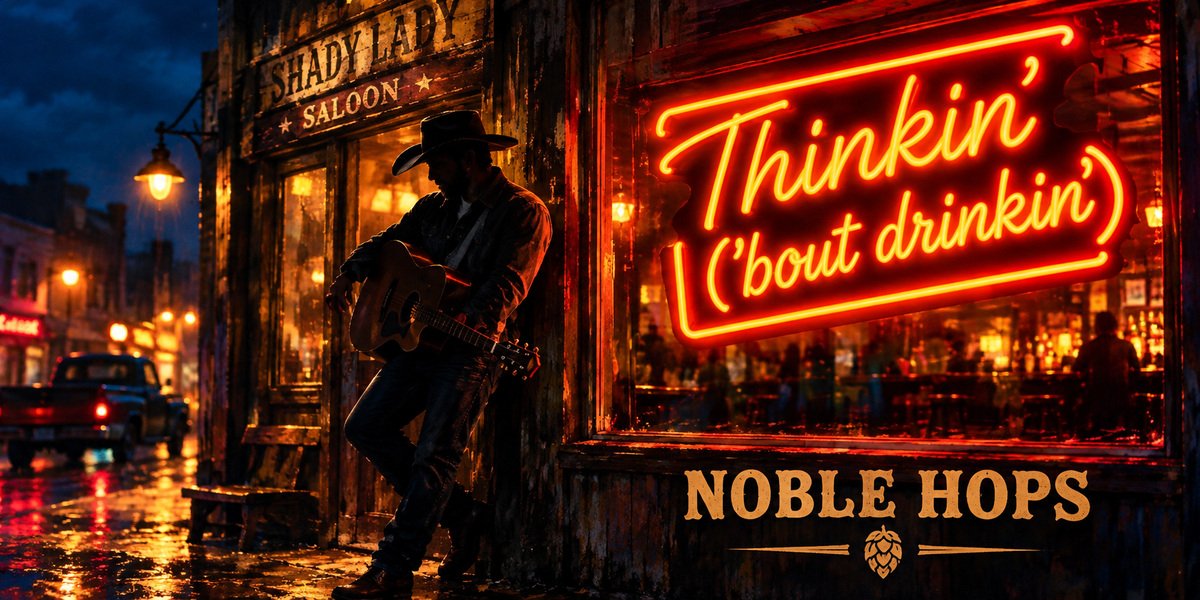
There is a peculiar contradiction at the heart of rock music’s relationship with alcohol. For generations, the bottle has represented freedom, camaraderie, and rebellion, even as the musicians celebrating it have frequently documented the wreckage left behind. Drinking songs tend to divide themselves between celebration and confession, between the exhilaration of surrendering control and the consequences that follow. Pittsburgh-area band Noble Hops enters that familiar territory with “Thinkin’ (‘Bout Drinkin’),” a single that considers what happens when the temporary relief of intoxication becomes a more permanent form of captivity.
Released October 10, 2026, the song is built around a deceptively simple proposition: drinking to avoid thinking eventually leaves a person with considerably more to think about.
The idea isn’t revolutionary. Country music, blues, and rock have returned to it for decades. But Noble Hops approaches the subject with an intriguing combination of self-awareness and traditional rock sensibilities, using an accessible, guitar-centered framework to explore the psychological contradictions of addiction.
The song also arrives with an unusual backstory. Frontman Utah Burgess originally composed its music nearly two decades ago, collaborating on the lyrics with Marty Roppolo, his former bandmate in B.U.M. The composition has now resurfaced through Noble Hops, a group whose name references the plant that gives beer much of its distinctive bitterness.
That irony is difficult to overlook. A band named in celebration of beer has recorded a song concerned with the consequences of consuming too much of it.
Yet Burgess doesn’t appear interested in constructing an argument against drinking itself. Instead, the song examines the moment when pleasure becomes a coping mechanism, and that mechanism begins to displace the rest of a person’s life.
The opening verse establishes the narrator’s condition without much introduction. He’s drinking directly from the bottle, following liquor with beer and losing control over his speech. His behavior becomes increasingly reckless, while his ability to recognize the consequences seems to diminish with each drink.
These details aren’t especially poetic, nor do they need to be. Their familiarity is central to the song’s effectiveness. The narrator isn’t a glamorous outsider or romanticized rebel. He’s an ordinary person making recognizable mistakes.
The chorus provides the composition’s clearest statement:
“Now I’m thinkin’, ’bout drinkin’ / And I’m drinkin’, to keep from thinkin’.”
The repetition does more than establish a memorable hook. It creates a linguistic loop that mirrors the behavior being described. Thinking leads to drinking, which becomes a means of avoiding thought, which ultimately produces the anxiety that makes another drink seem necessary.
The words circle without progressing. So does the narrator.
It’s a familiar psychological predicament presented in language that audiences can immediately understand. The song doesn’t require elaborate metaphors because its central paradox is already compelling.
Musically, Noble Hops positions the track within a harder rock framework than some of its other material. Burgess handles vocals and electric rhythm guitar, while Tony Villella contributes lead and rhythm guitar. Johnny “Sleeves” Costa supplies bass, and Brad Hurlburt plays drums.
The recording was produced, engineered, mixed, and mastered by Jazz Byers at Rattle Clack Studio, with Burgess serving as co-producer.
The band’s choice of a heavier rock approach creates an interesting relationship between subject and presentation. Rock’s conventional musical vocabulary often communicates confidence and power, while these lyrics describe a man steadily losing both.
That tension is essential to the song’s identity. The narrator’s unraveling stands in contrast to the assertive traditions of the genre carrying his confession. What might otherwise become a familiar drinking anthem is redirected toward an examination of vulnerability.
The second verse expands the consequences beyond the narrator himself. A relationship has ended, and the woman who once promised to remain by his side has disappeared.
The revelation arrives without elaborate explanation. He was drinking; he failed to recognize what was happening; when sobriety returned, she was gone.
What’s striking is how little the narrator appears to understand about his own circumstances. He recognizes the loss but offers no convincing explanation for the behavior that caused it.
That uncertainty is arguably more revealing than a detailed confession would have been. Addiction frequently involves not only the inability to stop harmful behavior but also the difficulty of recognizing its consequences while they are unfolding.
Noble Hops doesn’t resolve that contradiction. The song returns to its chorus, reinforcing the repetitive structure of the narrator’s predicament.
The choice of release date adds another dimension. October 10 is World Mental Health Day, and Burgess has explicitly connected the song’s subject to the ways alcohol can become a substitute for confronting unresolved emotional problems.
There is a distinction worth preserving here. The song isn’t a clinical account of addiction, nor does it attempt to explain every dimension of substance dependence. Its focus is narrower and more personal: the experience of someone who knows his behavior is destructive but continues repeating it.
That perspective also complicates the relationship between individual responsibility and emotional distress. The narrator’s choices have consequences, particularly for the woman who leaves him. Yet his repeated attempts to silence his thoughts suggest a person struggling with something he cannot readily articulate.
The song allows those realities to coexist without offering an easy explanation.
Perhaps the most interesting quality of “Thinkin’ (‘Bout Drinkin’)” is its refusal to provide the redemption that popular music frequently demands. There’s no final declaration of sobriety, no recovered relationship, no reassuring promise that tomorrow will be different.
Instead, the song ends with the same fears that have shaped it from the beginning: the possibility of losing control and revealing an uglier version of oneself.
It’s an appropriately unsettled conclusion.
For Noble Hops, the single represents more than a departure into harder rock. It demonstrates how conventional musical forms can accommodate uncomfortable emotional realities without abandoning their accessibility.
Rock music has always been capable of examining the consequences of its own mythology. Some of its most enduring songs have emerged from the distance between the liberation it promises and the damage that liberation can conceal.
“Thinkin’ (‘Bout Drinkin’)” belongs to that conversation.
Its central insight is straightforward, but its implications are less easily dismissed: sometimes the things people use to escape themselves become the very things that prevent them from moving forward.
And sometimes the most revealing drinking song is the one that stops celebrating long enough to ask why the drinking began.