
Music Observer

The Avalanches Release “No Bad Memories,” A 31-Track Fourth Album Featuring Carly Simon, Karen O And Jamie xx


The Avalanches released their fourth studio album, “No Bad Memories,” on October 16, 2026, via Modular Recordings. The 31-track record features Carly Simon, Karen O, Jamie xx, Rivers Cuomo, Mike Patton and Haruomi Hosono, and builds its sound from commercial jingles, tech start-up chimes and half-remembered audio logos.

Key Takeaways

  • “No Bad Memories” is the Australian group’s first album since 2020’s “We Will Always Love You.”
  • Four singles preceded the release, featuring Karen O, Jamie xx, Portraits of Tracy, and a trio of Nikki Nair, Jessy Lanza and Prentiss.
  • The Avalanches now operate as a trio of Robbie Chater, Tony Di Blasi and multi-instrumentalist Andy Szekeres.
  • Artwork by Jonathan Zawada depicts cartoon iPod and floppy disk characters, a visual cue for the album’s theme.
  • The group’s catalog has passed 1 million album sales and 700 million streams.

A Concept Album About Advertising And Memory

“No Bad Memories” takes on a subject that fits The Avalanches’ sample-driven method unusually well. According to the group’s announcement, the album is inspired by the simultaneously magical and insidious ways advertising and name-brand technology attach themselves to memory.

Rather than pulling primarily from obscure records, Robbie Chater and Tony Di Blasi revisited the jingles, sounds and imagery that surrounded them growing up. They then cut those corporate fragments apart and rebuilt them into pop songs. The result is an album that treats a startup chime or a forgotten TV jingle as raw material with emotional weight.

That premise carries a built-in tension. The sounds that make “No Bad Memories” feel nostalgic are the same sounds designed to sell products. The Avalanches present the album as an ambivalent tribute, leaving listeners to decide whether the warm feeling comes from childhood or from marketing.

The Singles Mapped A Wide Guest List Before Release Day

The Avalanches spent the summer previewing “No Bad Memories” through a run of collaborations. “Blue Shadows” paired the group with Karen O of the Yeah Yeah Yeahs. “Every Single Weekend” brought in Jamie xx, extending a working relationship that also produced “All You Children” on Jamie xx’s 2024 album “In Waves.”

“Together” featured Nikki Nair, Jessy Lanza and Prentiss, three artists rooted in club and electronic music. The fourth single, “Can’t Get Over Losing You,” arrived alongside the album announcement and features Portraits of Tracy, a self-taught Louisiana producer and artist. The track sets garage-rock drums against the group’s familiar nostalgic samples. Chater described Tracy in the announcement as a hilarious, brave and tender person.

The full album widens the circle further. Carly Simon, Faith No More’s Mike Patton, Yellow Magic Orchestra co-founder Haruomi Hosono and Weezer frontman Rivers Cuomo all appear, the latter arriving shortly after Weezer’s return to four-guys-in-a-room rock on the Gold Album.

The Avalanches Have Never Worked On A Fixed Schedule

The release of “No Bad Memories” stands out partly because of how The Avalanches have historically worked. Their 2000 debut, “Since I Left You,” was assembled from thousands of samples and became a reference point for collage-based pop. The follow-up, “Wildflower,” did not arrive until 2016, a 16-year gap that became part of the group’s legend.

“We Will Always Love You” followed in 2020, shifting the group toward live vocalists and outside collaborators. “No Bad Memories” continues that approach, combining guest performances with sampled source material across 31 tracks.

The six-year gap between the third and fourth albums is short by The Avalanches’ standards. For a group whose method depends on finding, editing and clearing large volumes of source material, a steadier release pace signals a more settled working process.

Sampling Corporate Sound Raises Practical Questions

The album’s concept also places it in an interesting position for the music business. Sample-based records have long faced clearance hurdles, since every recognizable fragment typically requires permission from rights holders. Building an album around advertising audio adds another layer, as jingles and audio logos are often owned by companies that guard them as brand assets.

The Avalanches’ choice to work with corporate sound, rather than avoid it, makes “No Bad Memories” a useful case study for producers. It raises questions about where homage ends and licensing begins, and how much of a sound must be transformed before it becomes something new.

For listeners, those questions sit beneath the surface. What comes through first is the group’s signature mix of euphoria and wistfulness, applied to a sonic world most people absorbed without ever choosing to.

Release Details And Formats

“No Bad Memories” is out now on streaming platforms and in physical formats, including a 180-gram yellow double vinyl edition. Modular Recordings handles the release, with EMI Australia releasing the album in the group’s home market. Artwork for the album and its singles was created by Jonathan Zawada.

FAQs

When Did The Avalanches Release No Bad Memories?

The Avalanches released “No Bad Memories” on Friday, October 16, 2026, via Modular Recordings.

Who Is Featured On The Avalanches’ No Bad Memories?

Guests include Carly Simon, Karen O, Jamie xx, Rivers Cuomo, Mike Patton, Haruomi Hosono, Portraits of Tracy, Nikki Nair, Jessy Lanza and Prentiss.

How Many Songs Are On No Bad Memories?

“No Bad Memories” contains 31 tracks, continuing the long-form structure of the group’s previous albums.

Who Are The Members Of The Avalanches?

The Avalanches are Robbie Chater, Tony Di Blasi and Andy Szekeres. Chater and Di Blasi are founding members, and Szekeres is the group’s multi-instrumentalist.

What Is No Bad Memories About?

The album explores how advertising and consumer technology become part of personal memory, using commercial jingles, startup sounds and audio logos as source material.

ARGYRO’s “She’s So LA” Examines the Seductive Distance Between Hollywood Fantasy and Romantic Reality

By: Christopher Bennett

Denver-based multi-instrumentalist transforms California glamour into a cinematic pop-rock meditation on attraction, identity, and the personalities we invent.

Los Angeles has long served two functions in popular music. It is a geographical destination, with its freeways, palm trees, and Hollywood landmarks, but it is also an elaborate collection of expectations. The city promises reinvention, celebrity, perpetual sunshine, and the possibility that ordinary existence might somehow become extraordinary. Those expectations have supplied generations of songwriters with material, often revealing more about the people pursuing the dream than the place itself.

On “She’s So LA,” Denver-based singer-songwriter and multi-instrumentalist ARGYRO, the recording identity of Scott Argiro, approaches that familiar mythology through a more intimate subject: romantic attraction.

The woman at the center of the song isn’t simply associated with Los Angeles. She appears to personify it. Her appeal becomes inseparable from the cultural assumptions surrounding the city, where glamour suggests possibility and self-presentation can become a form of personal identity.

The title is revealing. “She’s So LA” functions simultaneously as a description, an expression of admiration, and a potentially skeptical observation. Depending on the listener’s perspective, it might suggest sophistication, confidence, superficiality, or the calculated effortlessness that celebrity culture has made fashionable.

Argiro leaves room for those interpretations without allowing them to overwhelm the song’s melodic accessibility.

Musically, “She’s So LA” belongs to the tradition of guitar-oriented pop-rock that values memorable songwriting over elaborate displays of instrumental virtuosity. Its arrangement emphasizes cohesion, with the instruments working collectively to establish an atmosphere that supports the central romantic fascination.

Argiro performed all studio instruments and vocals except lead and rhythm guitars, contributed by Damon Wood. That largely self-contained approach is significant because it allows the recording to maintain a consistent musical perspective.

Wood’s guitars introduce an additional voice, reinforcing the song’s rock foundation while complementing its polished melodic sensibility. The arrangement balances accessibility with enough instrumental character to avoid becoming merely decorative.

Mixed and mastered by Jesse O’Brien in Denver, the recording reflects a preference for clarity and control. Rather than making the production itself the principal attraction, Argiro places the emphasis on the song’s melodic structure and the personality of its subject.

That decision is especially appropriate for material concerned with appearances.

There is an interesting relationship between the song’s subject and its musical presentation. Los Angeles is frequently represented through excess: conspicuous wealth, exaggerated personalities, relentless ambition, and the perpetual demand for attention. Yet “She’s So LA” approaches that world through comparatively direct songwriting.

The contrast suggests that Argiro is less interested in reproducing the city’s spectacle than in understanding its emotional appeal.

His larger Glitterati project provides useful context. Across the collection, Argiro explores celebrity, romance, identity, and the complications of presenting oneself to an audience. These subjects have become increasingly difficult to separate in contemporary culture, where the boundaries between personal relationships and public performance are frequently blurred.

Social media has accelerated that transformation. Ordinary individuals now construct public identities using techniques once associated primarily with professional entertainers: carefully selected images, controlled narratives, and the continuous cultivation of attention.

Within that environment, describing someone as “so LA” no longer requires an actual connection to Southern California. It can refer to an entire philosophy of self-presentation.

The woman in Argiro’s song becomes an embodiment of that philosophy, although the recording doesn’t insist that listeners regard her critically.

Instead, it acknowledges the pleasure of fascination.

This distinction is important. Popular music has always depended upon exaggeration, particularly when describing romance. The beloved becomes extraordinary, the ordinary encounter becomes destiny, and personal attraction acquires an almost mythological significance.

“She’s So LA” participates in that tradition while recognizing the cultural imagery that makes the fantasy possible.

Argiro’s background as an actor adds another dimension to the song. His approach to songwriting frequently emphasizes characters, atmosphere, and visual imagination. Rather than presenting a detailed psychological portrait, he establishes a recognizable figure and allows listeners to complete the characterization themselves.

That technique resembles filmmaking, where costume, setting, movement, and framing can communicate personality before a character speaks.

The accompanying music video, directed by Denver filmmaker Elgin Cahill, extends that connection between music and visual storytelling. It also highlights an intriguing geographical detail: the entire recording was created in Colorado.

Los Angeles supplies the mythology, but Denver provides the creative foundation.

That distance is more than a production footnote. American popular music has frequently depended upon imagined places, with cities becoming symbols of freedom, danger, sophistication, or escape for artists living elsewhere.

California’s cultural influence has been particularly enduring because its image is so easily separated from its physical reality.

Argiro approaches the city as both an admirer and an observer, drawn toward its promises without necessarily accepting them at face value.

What ultimately gives “She’s So LA” its appeal is the relationship between that cultural awareness and the song’s uncomplicated melodic pleasures.

The recording doesn’t attempt to resolve the contradictions of celebrity culture or offer a definitive judgment about romantic idealization. Nor does it need to. Its subject is the experience of attraction, and attraction rarely begins with an objective assessment of another person’s character.

Instead, it begins with impressions, associations, and possibilities.

A person becomes a collection of imagined qualities. A city becomes a personality. A fleeting fascination becomes the foundation for a song.

ARGYRO understands that process and translates it into a polished, approachable pop-rock recording that fits comfortably within the larger concerns of Glitterati.

“She’s So LA” may be built around the imagery of Hollywood glamour, but its underlying subject is more universal: the human tendency to fall in love not only with people, but with what we believe those people represent.

The song’s achievement lies in making that distinction perceptible without diminishing the pleasure of the fantasy. Argiro doesn’t need to dismantle the dream. He simply allows listeners to recognize themselves in the act of believing it.

Watch the Official music video.

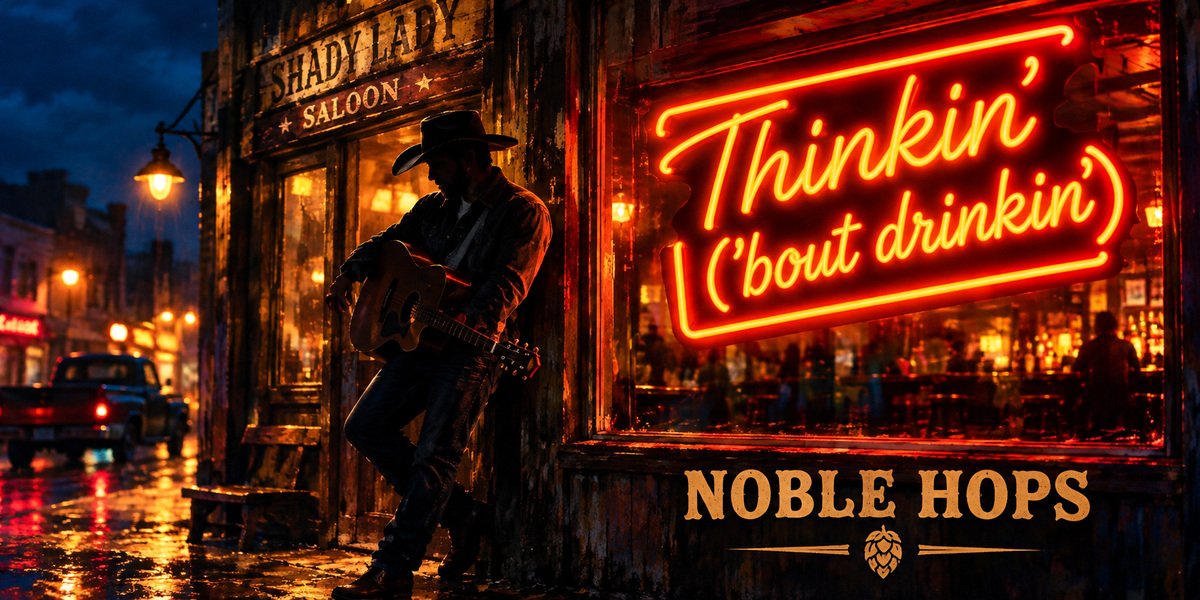
Noble Hops Finds the Sobering Truth Beneath Rock’s Drinking Culture on “Thinkin’ (‘Bout Drinkin’)”

By: John Parker

There is a peculiar contradiction at the heart of rock music’s relationship with alcohol. For generations, the bottle has represented freedom, camaraderie, and rebellion, even as the musicians celebrating it have frequently documented the wreckage left behind. Drinking songs tend to divide themselves between celebration and confession, between the exhilaration of surrendering control and the consequences that follow. Pittsburgh-area band Noble Hops enters that familiar territory with “Thinkin’ (‘Bout Drinkin’),” a single that considers what happens when the temporary relief of intoxication becomes a more permanent form of captivity.

Released October 10, 2026, the song is built around a deceptively simple proposition: drinking to avoid thinking eventually leaves a person with considerably more to think about.

The idea isn’t revolutionary. Country music, blues, and rock have returned to it for decades. But Noble Hops approaches the subject with an intriguing combination of self-awareness and traditional rock sensibilities, using an accessible, guitar-centered framework to explore the psychological contradictions of addiction.

The song also arrives with an unusual backstory. Frontman Utah Burgess originally composed its music nearly two decades ago, collaborating on the lyrics with Marty Roppolo, his former bandmate in B.U.M. The composition has now resurfaced through Noble Hops, a group whose name references the plant that gives beer much of its distinctive bitterness.

That irony is difficult to overlook. A band named in celebration of beer has recorded a song concerned with the consequences of consuming too much of it.

Yet Burgess doesn’t appear interested in constructing an argument against drinking itself. Instead, the song examines the moment when pleasure becomes a coping mechanism, and that mechanism begins to displace the rest of a person’s life.

The opening verse establishes the narrator’s condition without much introduction. He’s drinking directly from the bottle, following liquor with beer and losing control over his speech. His behavior becomes increasingly reckless, while his ability to recognize the consequences seems to diminish with each drink.

These details aren’t especially poetic, nor do they need to be. Their familiarity is central to the song’s effectiveness. The narrator isn’t a glamorous outsider or romanticized rebel. He’s an ordinary person making recognizable mistakes.

The chorus provides the composition’s clearest statement:

“Now I’m thinkin’, ’bout drinkin’ / And I’m drinkin’, to keep from thinkin’.”

The repetition does more than establish a memorable hook. It creates a linguistic loop that mirrors the behavior being described. Thinking leads to drinking, which becomes a means of avoiding thought, which ultimately produces the anxiety that makes another drink seem necessary.

The words circle without progressing. So does the narrator.

It’s a familiar psychological predicament presented in language that audiences can immediately understand. The song doesn’t require elaborate metaphors because its central paradox is already compelling.

Musically, Noble Hops positions the track within a harder rock framework than some of its other material. Burgess handles vocals and electric rhythm guitar, while Tony Villella contributes lead and rhythm guitar. Johnny “Sleeves” Costa supplies bass, and Brad Hurlburt plays drums.

The recording was produced, engineered, mixed, and mastered by Jazz Byers at Rattle Clack Studio, with Burgess serving as co-producer.

The band’s choice of a heavier rock approach creates an interesting relationship between subject and presentation. Rock’s conventional musical vocabulary often communicates confidence and power, while these lyrics describe a man steadily losing both.

That tension is essential to the song’s identity. The narrator’s unraveling stands in contrast to the assertive traditions of the genre carrying his confession. What might otherwise become a familiar drinking anthem is redirected toward an examination of vulnerability.

The second verse expands the consequences beyond the narrator himself. A relationship has ended, and the woman who once promised to remain by his side has disappeared.

The revelation arrives without elaborate explanation. He was drinking; he failed to recognize what was happening; when sobriety returned, she was gone.

What’s striking is how little the narrator appears to understand about his own circumstances. He recognizes the loss but offers no convincing explanation for the behavior that caused it.

That uncertainty is arguably more revealing than a detailed confession would have been. Addiction frequently involves not only the inability to stop harmful behavior but also the difficulty of recognizing its consequences while they are unfolding.

Noble Hops doesn’t resolve that contradiction. The song returns to its chorus, reinforcing the repetitive structure of the narrator’s predicament.

The choice of release date adds another dimension. October 10 is World Mental Health Day, and Burgess has explicitly connected the song’s subject to the ways alcohol can become a substitute for confronting unresolved emotional problems.

There is a distinction worth preserving here. The song isn’t a clinical account of addiction, nor does it attempt to explain every dimension of substance dependence. Its focus is narrower and more personal: the experience of someone who knows his behavior is destructive but continues repeating it.

That perspective also complicates the relationship between individual responsibility and emotional distress. The narrator’s choices have consequences, particularly for the woman who leaves him. Yet his repeated attempts to silence his thoughts suggest a person struggling with something he cannot readily articulate.

The song allows those realities to coexist without offering an easy explanation.

Perhaps the most interesting quality of “Thinkin’ (‘Bout Drinkin’)” is its refusal to provide the redemption that popular music frequently demands. There’s no final declaration of sobriety, no recovered relationship, no reassuring promise that tomorrow will be different.

Instead, the song ends with the same fears that have shaped it from the beginning: the possibility of losing control and revealing an uglier version of oneself.

It’s an appropriately unsettled conclusion.

For Noble Hops, the single represents more than a departure into harder rock. It demonstrates how conventional musical forms can accommodate uncomfortable emotional realities without abandoning their accessibility.

Rock music has always been capable of examining the consequences of its own mythology. Some of its most enduring songs have emerged from the distance between the liberation it promises and the damage that liberation can conceal.

“Thinkin’ (‘Bout Drinkin’)” belongs to that conversation.

Its central insight is straightforward, but its implications are less easily dismissed: sometimes the things people use to escape themselves become the very things that prevent them from moving forward.

And sometimes the most revealing drinking song is the one that stops celebrating long enough to ask why the drinking began.