By: Catherine Zhou
In today’s musical world, the finest collaborative pianists are those who transcend the traditional notion of “accompaniment.” They listen, breathe, and shape musical narratives alongside their partners as equal storytellers. Among the emerging artists demonstrating this rare instinct is Dr. Guhan Peng, a pianist whose artistry combines the authority of a soloist with the sensitivity of a seasoned collaborator.
Peng first came to broader attention as a compelling solo pianist. A graduate of the Eastman School of Music, where he earned the Doctor of Musical Arts in Piano Performance and Literature, he belongs to the lineage of pianists trained at one of the world’s most rigorous conservatories. His playing reflects the clarity of structure and intellectual discipline long associated with Eastman’s piano tradition, while maintaining a natural lyricism that speaks directly to audiences. Even in solo repertoire, Peng’s musical language carries a vocal quality—phrases unfold as though sung rather than struck from the keyboard.
Yet it is in collaborative work that Peng’s musicianship reveals its most distinctive qualities. Peng’s artistry is also supported by a formidable technical foundation. His playing combines clarity of articulation, refined tonal control, and remarkable rhythmic stability—qualities that allow him to navigate complex textures and demanding repertoire with ease. Whether in solo literature or collaborative settings, Peng demonstrates a level of technical assurance that enables musical ideas to unfold naturally and without constraint. Rather than drawing attention to virtuosity for its own sake, his technique functions as an invisible framework that supports expressive freedom and sensitive musical dialogue.
For several years, he has been deeply involved in the operatic world, serving as an opera coach at Eastman, where he participated in the production of more than fifteen operas at the Eastman Theatre. In the demanding environment of opera rehearsal rooms, where singers rely on the pianist not merely for harmonic support but for dramatic guidance, Peng developed an acute sensitivity to the nuances of vocal phrasing and theatrical timing. Opera pianists must think orchestrally while simultaneously anticipating the breath and intention of singers. Peng demonstrates precisely this dual awareness.
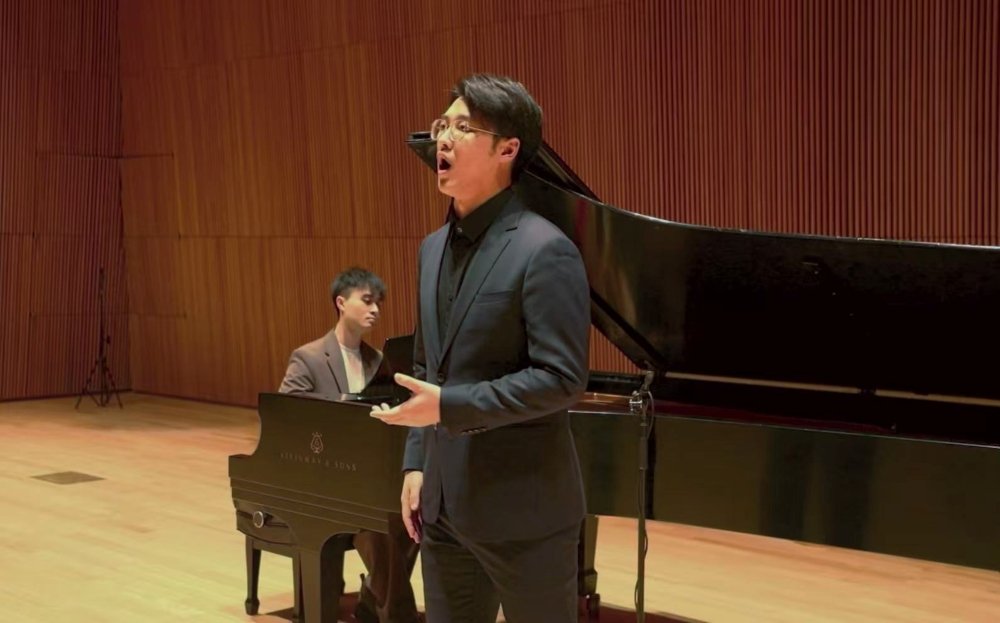
Photo Courtesy: Deng and Dr. Peng (DiMenna Center, New York)
His operatic experience expanded beyond the rehearsal studio. He served as Associate Conductor with Maryland Lyric Opera, an appointment that placed him at the intersection of conducting, coaching, and collaborative performance. Such roles require the musician to navigate between artistic leadership and responsiveness—qualities that have clearly shaped Peng’s approach at the keyboard.
Peng’s collaborative career has also brought him into contact with major orchestral institutions, including work with the Rochester Philharmonic Orchestra, further broadening his perspective on ensemble performance. Exposure to orchestral rehearsal processes and large-scale musical architecture has refined his sense of balance, color, and dramatic pacing—traits that translate seamlessly into chamber and vocal collaborations.
Listening to Peng accompany singers, one notices immediately the vocal nature of his playing. His phrasing often mirrors the elasticity of the human voice; lines swell and recede naturally, as if guided by breath rather than by the rigid pulse of the metronome. In rehearsal rooms and on stage alike, he appears to “breathe” with his musical partners. The result is a kind of shared suspension of time: singer and pianist shaping the phrase together while the audience seems to hold its collective breath.
The operatic stage has also left a clear imprint on Peng’s musical imagination. Even in repertoire outside opera, there is an unmistakable dramatic awareness in his playing. Musical gestures unfold as narrative events, each phrase carrying a sense of character and intention. This phenomenon recalls a historical precedent: Sviatoslav Richter, widely regarded as one of the greatest pianists of the twentieth century, also began his career as an opera pianist before emerging as a legendary soloist. Like Richter, Peng appears to draw profound interpretive insight from the theater.
A recent performance at the DiMenna Center for Classical Music offered a striking demonstration of these qualities. Appearing alongside tenor Zhongjiancheng Deng, Peng displayed the kind of spontaneous musicianship that distinguishes exceptional collaborative pianists. During the concert, at the audience’s request, the duo performed a piece they had never rehearsed together, with Peng sight-reading the score.
What followed was nothing short of remarkable.
Rather than sounding tentative or improvised, the performance unfolded with the cohesion and assurance of a thoroughly prepared interpretation. Phrase by phrase, Peng responded to Deng’s vocal gestures with uncanny precision—matching breaths, anticipating rubato, and shaping harmonic support with instinctive timing. To listeners in the hall, the result felt less like sight-reading and more like the culmination of months of rehearsal.
Such moments reveal Peng’s most unusual gift: an almost telepathic sensitivity to musical partners. Many accompanists operate primarily by following the soloist’s lead, reacting after the fact to interpretive decisions. Peng, by contrast, seems to sense intention before it becomes audible. His playing suggests collaboration in the truest sense—two artists shaping a musical idea simultaneously rather than one merely supporting the other.
In this way, Peng challenges outdated hierarchies embedded in the term “accompanist.” His artistry reminds us that collaborative piano is not secondary work but a specialized discipline requiring imagination, empathy, and quick intelligence. At his best, Peng becomes less a follower than a co-creator of the musical moment.
For audiences, the experience is palpable. The pianist does not simply play the notes beneath the melody; he inhabits the drama alongside the singer, guiding the emotional arc of the performance from within the keyboard’s texture.
If recent performances are any indication, Guhan Peng represents a new generation of collaborative pianists who unite virtuosity with deep musical partnership. His background as a soloist, his immersion in the operatic world, and his instinctive rapport with fellow performers position him as an artist whose listening may prove just as powerful as his playing.