By: Tally Daniels
When The Porch on Windy Hill announced another extension, it did not feel like a surprise so much as a quiet affirmation. Since opening, the intimate actor-musician play has drawn audiences who leave the theater speaking softly, as if not to disturb something fragile they have just experienced. Critics have praised its restraint and emotional clarity. Audiences, meanwhile, have responded to its invitation to listen.
Set over the course of a single day, The Porch on Windy Hill centers on three people brought together by music and unfinished history. Mira, a classical violinist uncertain of her next step. Beck, her partner, is a folk musician and academic whose relationship to tradition is both studied and deeply personal. And Edgar, Mira’s estranged grandfather, is a formidable musical presence whose legacy carries both beauty and unresolved wounds. What unfolds is not nostalgia, nor a concert framed as drama, but a story in which music becomes the primary language of reckoning.
David M. Lutken, who plays Edgar and serves as the show’s music director and co-writer, describes the piece as an effort to make the relationship between sound and society visible. “We hope our play shows not only folk music’s connection to social history,” he says, “but how the two are inseparable.” For Lutken, the music does not decorate the story or comment upon it. It diagnoses it. “We want to hold the mirror up to our current cultural impasses,” he adds. “This music is that mirror.”
Throughout the play, traditional songs surface not as set pieces but as emotional interventions. A melody centuries old suddenly reframes a contemporary conflict. Familiar structures become unfamiliar when placed in new emotional contexts. The audience may not recognize every tune, but the emotional charge is immediate and unmistakable.
Lutken, whose career includes portraying figures such as Woody Guthrie, sees The Porch on Windy Hill as part of a larger continuum that resists rigid definitions of authenticity. “In this play, Edgar and Beck are both on both sides of that debate, in very different ways,” he explains. “And Mira is both an observer and a receiver, with her own emerging voice.” The musical language reflects that friction, from an erhu interpretation of “Pretty Polly” to the fusion of Bach and bluegrass that opens Act II.
That fusion marks a turning point for Mira, played by Tora Nogami Alexander, whose performance is grounded in restraint and precision. Mira enters the play hesitant, preferring silence to confrontation. Music becomes the space where her inner life can surface without explanation. “She would rather ignore conflict and run away to safety,” Alexander says. “Through the music she plays, she starts processing memory, and it both comforts her and unsettles her.”
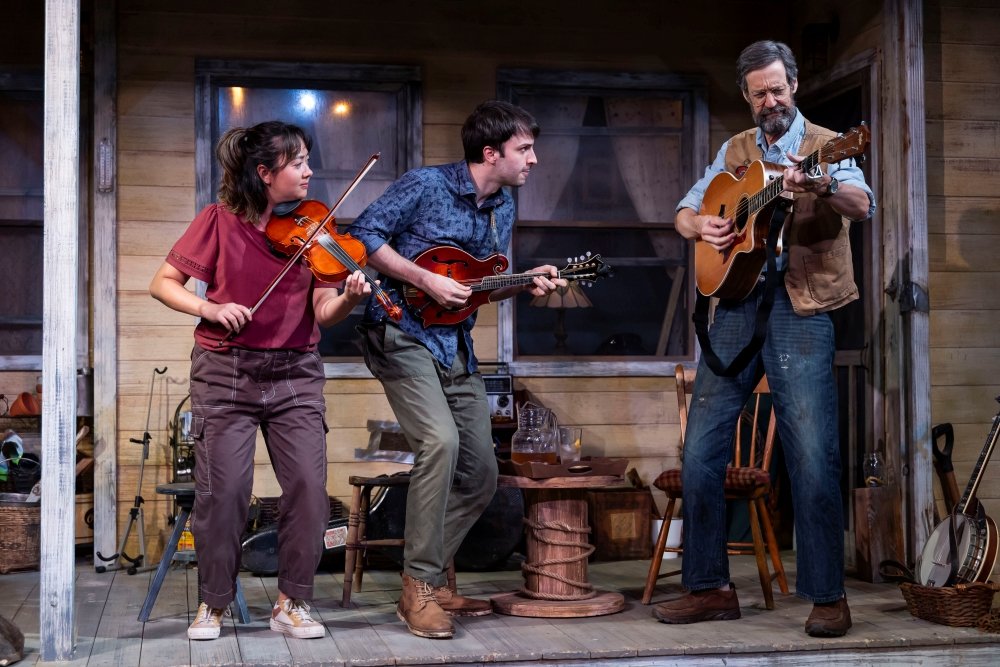
Photo Courtesy: Ben Hider (Tora Nogami Alexander, Morgan Morse, and David M. Lutken)
The emotional fulcrum arrives in an original musical soliloquy the company calls “Bach Berry,” blending Bach’s Minuet in G with the traditional tune “Blackberry Blossom.” “It’s confusing, but somehow harmonious,” Alexander says. “That is exactly where Mira is.” The moment is not a theatrical display but exposure, a character revealing herself through sound before she can do so in words.
Alexander, an actor-musician performing on her own violin, notes that the show’s three-person structure demands constant presence and attention. “There’s no place to hide in this show,” she says. “Listening is everything. Mira doesn’t want to speak for a long time. She listens instead. And eventually that gives her the confidence to speak, and then it’s the others’ turn to listen to her.”
Morgan Morse, who plays Beck and is also part of the writing team, sees that exchange as central to the show’s appeal, particularly for audiences who may not consider themselves folk music devotees. “There really is no single authentic way to come to folk music,” Morse says. “How you come to it is how you come to it, and all of those paths are legitimate.”
For Morse, folk music’s power lies in its communal authorship. “It’s a living connection to the past,” he says. “An oral history written by people for people.” Writing himself into the fabric of the play required allowing the character to be imperfect. “The more we leaned into those imperfections, the stronger the show became,” he adds. Humor and heartbreak coexist easily in folk traditions, and the play allows both to share the same space without contradiction.
Sherry Stregack Lutken, the show’s conceiver and director, describes The Porch on Windy Hill as “a new play with old music,” a phrase that reflects both its structure and its emotional core. “For so many of us, to move forward means looking back,” she says. “The old music becomes the bridge to both past and future.”
The songs were chosen with deliberate care, not for recognition but for resonance. “The audience may not know any of them,” she explains, “and yet something in them feels familiar.” That familiarity is not sentimental but instinctive, rooted in shared rhythms and emotional patterns that live deep within American musical DNA.
The pandemic shaped the play’s DNA in lasting ways. “Being distanced from our families and our artistic communities fueled a desire for connection,” Stregack Lutken says. “We were all asking how to really listen again.” That question reverberates throughout the play, which treats music not as escape but as dialogue. “The music begins as a way to avoid conversation,” she notes, “but it gradually opens channels that run deep.”
As the run continues to grow, conversations around the show’s future have begun to emerge organically, shaped less by ambition than by response. The questions are familiar ones for a piece this intimate. How far can something so quiet travel? Yet the themes at the heart of The Porch on Windy Hill suggest an answer. Music as shared language. Family as unresolved terrain. Listening as an act of care. These are not regional concerns, nor are they bound by geography. They are human ones, portable by nature, and newly resonant in a world hungry for connection.
If The Porch on Windy Hill has found an audience in New York, it is because it trusts audiences to meet it halfway. It does not rush toward resolution or insist on certainty. Instead, it offers music as a bridge and listening as a beginning. That approach feels increasingly rare, and increasingly necessary. Whether the play continues its life across the country or eventually finds a home beyond American borders, its quiet confidence suggests durability. Stories rooted in listening travel well. They always have. And when they arrive somewhere new, they tend to sound, somehow, like home.
Now playing at NYC’s Urban Stages (259 W 30 Street). For tickets and information, visit www.urbanstages.org