By David Marshall
Rock ’n’ roll has always had an uneasy relationship with salvation. It was born in the church, raised in the streets, and eventually sold to the highest bidder. Somewhere along the way, the music that once promised liberation became another commodity, packaged for consumption and measured by algorithms. But every so often, a song comes along that reminds us why people started making this noise in the first place. They needed answers. They needed connection. They needed something to believe in.
Albany, New York’s The Perfect Storm are asking those same questions with their latest single, “The Guide,” taken from the forthcoming album Nature’s Fury. And while the answers they offer are explicitly Christian, the struggle they describe belongs to anybody who’s ever looked at the wreckage of their own decisions and wondered how things went so terribly wrong.
The trio of James Krakat, Ethan Lynch, and Matty Kirtoglou aren’t trying to reinvent the machinery of rock music. Their approach is grounded in melody, muscular guitar work, and the kind of straightforward songwriting that values communication over cleverness. What distinguishes “The Guide” isn’t some revolutionary musical technique. It’s the conviction that popular music can still address serious questions without surrendering its accessibility.
The song begins with an admission of emotional exhaustion. Anger eats away at the heart. Nights become disorienting exercises in survival. Other people offer advice, confidently distinguishing right from wrong, although their own lives may be equally confused. It’s an unflattering portrait of human arrogance, and that’s precisely what makes it effective.
We live in a culture that rewards certainty, even when certainty is entirely undeserved. Everybody has an opinion, everybody claims expertise, and everybody seems eager to tell somebody else how to live. The Perfect Storm recognize the absurdity of that arrangement. Their narrator has listened to the noise, trusted his own judgment, and discovered that neither has provided the answers he needs.
The chorus supplies the alternative: a guide who remains present even when the traveler loses his bearings.
The band identifies that guide as Jesus Christ, leaving little room for ambiguity. In an era when musicians frequently dilute their beliefs to avoid alienating potential listeners, that directness deserves acknowledgment. It also raises a legitimate artistic question: can a song rooted in a specific religious conviction communicate meaningfully with people who don’t share that faith?
“The Guide” makes a persuasive case that it can.
The reason is simple. The song begins with a recognizable human problem rather than a theological argument. Its emotional foundation is frustration, regret, and the fear of being lost. You don’t have to accept the band’s spiritual conclusions to understand the desperation that produces them.
Musically, The Perfect Storm operate within a familiar tradition of melodic rock. The arrangement favors clarity over clutter, allowing the chorus to carry the central idea without unnecessary complication. The guitars provide muscle, but they don’t overwhelm the song’s purpose. An extended solo supplies the emotional release, recalling an era when instrumental passages were expected to contribute something beyond technical exhibitionism.
That distinction matters. Rock guitar has too often become either a museum piece or a demonstration of athletic ability. Here, the solo functions as an expression of urgency, reinforcing the tension between confusion and resolution.
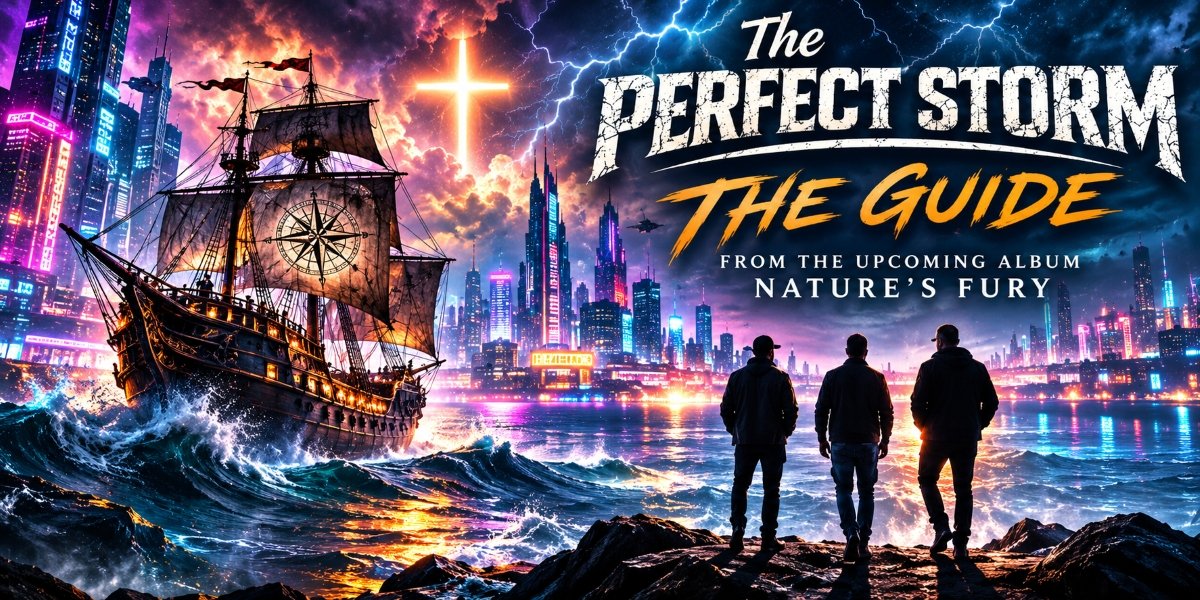
The accompanying music video takes a considerably more extravagant approach. Set against the glowing architecture of a futuristic city, it introduces a pirate ship navigating a strange landscape where science fiction and historical adventure collide. Neon lights illuminate towering skyscrapers while an ancient vessel travels through a world that seems to have abandoned ordinary rules of time and geography.
On paper, the concept sounds ridiculous. In practice, its symbolism is surprisingly coherent.
A ship requires navigation, regardless of how advanced the surrounding civilization becomes. The futuristic skyline suggests technological progress, but the vessel represents humanity’s continuing dependence on direction. We can construct increasingly sophisticated machines without necessarily becoming wiser about where we’re going.
It’s an effective visual metaphor for a song concerned with the limitations of human judgment.
There’s also something refreshingly independent about the video’s ambition. Rather than settling for another performance clip assembled from predictable angles and dramatic lighting, The Perfect Storm attempt to create an imaginative environment around their music. The result may be theatrical, but it demonstrates a willingness to treat the music video as an extension of the song’s ideas rather than merely an advertisement.
The band’s commercial progress provides additional context. Multiple No. 1 placements on the National Radio Hits charts, a Top 40 Mediabase Activator hit, and numerous New Music Weekly chart appearances suggest that their melodic approach has found an audience beyond the usual boundaries of regional independent rock.
Those achievements are significant, particularly when independent artists face enormous obstacles in securing radio exposure. Yet they shouldn’t become the primary measure of the band’s worth. A chart position tells us that a record received attention. It doesn’t tell us whether the music has anything meaningful to say.
“The Guide” does.
Its greatest strength is its willingness to acknowledge human weakness without treating that weakness as a permanent condition. The song doesn’t celebrate self-destruction, romanticize despair, or suggest that confusion is somehow fashionable. Instead, it argues that recognizing our limitations can become the beginning of transformation.
There are limitations, too. The lyrics occasionally favor blunt declaration over imagery, and the repeated chorus leaves little room for ambiguity or unexpected interpretation. Listeners who prefer their rock music more lyrically complex may find the message overly direct. But directness has its own tradition in popular music, particularly when the emotional stakes are genuine.
From gospel and soul to folk protest songs and working-class rock, some of the most enduring records have succeeded because they communicated an essential truth without hiding behind elaborate language.
The Perfect Storm belong to that broader tradition, even if their musical vocabulary is distinctly contemporary.
With Nature’s Fury approaching, “The Guide” suggests a band increasingly interested in the relationship between personal struggle and collective understanding. Krakat, Lynch, and Kirtoglou are writing about faith, but they’re also writing about responsibility: the consequences of poor choices, the danger of misplaced confidence, and the necessity of recognizing when help is needed.
That’s a worthwhile subject for rock music, which has spent much of its history celebrating the freedom to make mistakes while paying considerably less attention to what happens afterward.
Ultimately, “The Guide” isn’t asking listeners to admire the musicians’ certainty. It’s asking them to consider the uncertainty that made their faith necessary.
And in a world overflowing with information but frequently starving for wisdom, that’s a question worth turning up the volume to hear.