By Marcus J. Fallon
Every once in a while, a song comes along that reminds you music doesn’t always need to know where it’s going before it gets there.
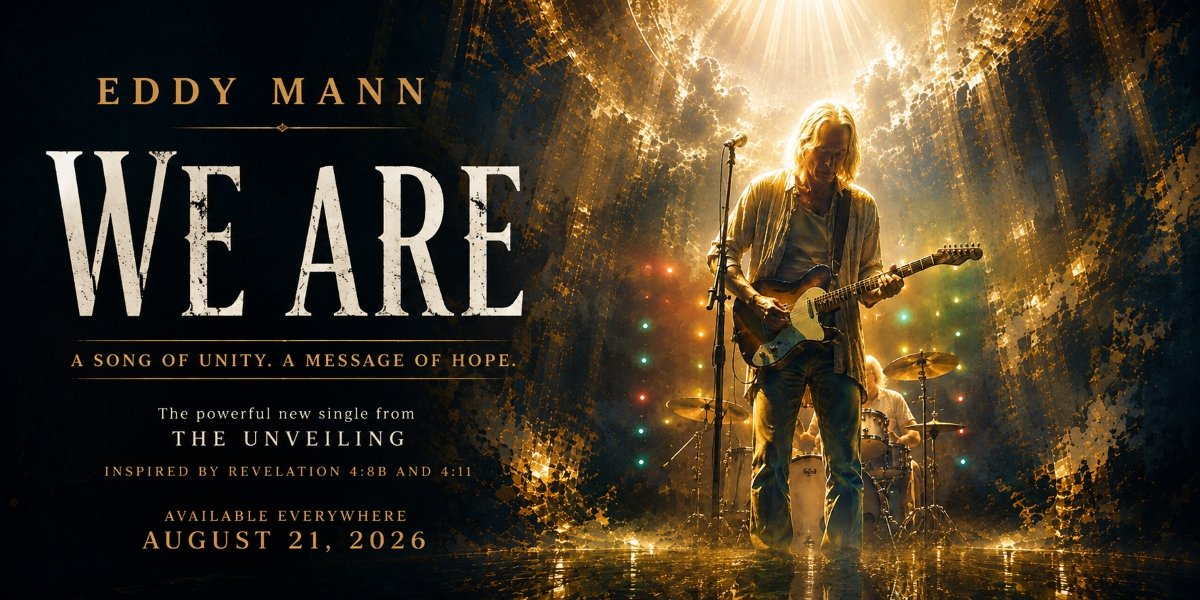
Eddy Mann’s “We Are” is one of those songs.
The veteran singer-songwriter and minister’s latest single, drawn from his Revelation-inspired album The Unveiling, begins with one of Christianity’s oldest declarations—“Holy, holy, holy”—and then does something unexpected. It swings into an organic 5/4 meter, wraps Scripture in jazz-inflected harmony, and asks the listener to consider a concept that’s simultaneously ancient and desperately relevant in 2026:
What if “we” mattered more than “me”?
Mann says he never intended to write “We Are” in 5/4. The song emerged during a quiet time of worship inspired by Revelation 4:8b and 4:11, and the rhythm simply appeared.
That’s exactly how great musical moments often happen.
You don’t manufacture them.
You recognize them.
The five-beat pulse is important because it gives “We Are” an identity immediately separating it from much of contemporary worship music. This isn’t the enormous arena chorus waiting for thousands of hands to rise on cue. Nor does Mann attempt to transform Revelation into the soundtrack for Armageddon.
He’s after something considerably more intimate.
Listen to the heart of the lyric:
“We are Your will
We are Your desire
We are Your pleasure.”
That’s a staggering amount of theology packed into a handful of words.
Most of us spend enormous amounts of energy attempting to justify our existence. Careers. Money. Status. Relationships. Followers. Accomplishments. We collect evidence suggesting that our lives matter and then spend sleepless nights wondering whether we’ve collected enough.
Mann proposes another possibility.
What if being created means being wanted?
The thought would be powerful enough if “We Are” were merely about the individual’s relationship with God. But Mann chooses his pronoun carefully.
It’s we.
That distinction becomes increasingly meaningful when you consider the cultural atmosphere surrounding the record. Everywhere you turn, somebody seems determined to explain why another group of people is responsible for everything that’s wrong. Politics divides. Social media amplifies the division. Even religion—the institution supposedly concerned with reconciliation—can become another place where humans sort themselves into teams.
Mann has described divisive rhetoric as something that “nourishes separation.”
That’s a terrific phrase because separation does need nourishment.
So does unity.
“We Are” feeds the latter.
Musically, jazz turns out to be the perfect language for the idea. Jazz has always been an ongoing negotiation between individual expression and collective purpose. Every player has a voice, but everyone also has to listen. Push too hard toward individuality and the ensemble collapses. Demand absolute conformity and you’ve killed the thing that makes jazz alive.
That’s not far removed from Mann’s vision of humanity.
Unity isn’t sameness.
“We Are” never asks anyone to disappear into the crowd. Instead, it suggests that individual lives might form part of something larger.
The song also makes more sense within The Unveiling, Mann’s album devoted to the Book of Revelation. Popular culture has spent generations turning Revelation into Christianity’s horror franchise: beasts, plagues, horsemen, fire, judgment and ominous predictions about precisely when the world is going to end.
Mann reads the same book and finds love.
Of course he does.
After decades of music and ministry, Mann has become an artist whose instinct is almost always to look through the darkness rather than merely describe it. Another Unveiling standout, “I Will Never Know the Desert Again,” looks at suffering and imagines its conclusion. “We Are” looks at division and imagines connection.
Neither song pretends darkness isn’t real.
That’s what keeps the optimism from becoming cheap.
Mann’s voice carries that history. There is no youthful need to impress, no attempt to bend himself toward whatever contemporary Christian radio supposedly wants this month. He sings with the confidence of somebody who has accumulated enough miles to understand that volume and conviction aren’t the same thing.
The arrangement follows his lead.
Nothing screams.
Nothing begs.
The music simply unfolds.
And that fifth beat keeps returning.
One-two-three-four-five.
It creates a subtle feeling that something doesn’t quite fit the expected pattern. Just as you’re ready for the measure to resolve, there’s another step.
Maybe that’s why the song feels so spiritually authentic.
Faith rarely happens in four-four.
Life certainly doesn’t.
You think you’ve figured out the rhythm and suddenly there’s an extra beat: a death, a birth, a diagnosis, a marriage, a loss, a miracle, a phone call at two in the morning. The measure changes and somehow you keep playing.
Mann has spent more than three decades doing exactly that.
Which brings us back to Revelation.
For all its terrifying reputation, Revelation ultimately asks its readers to imagine something beyond the world directly in front of them. Mann takes that invitation seriously without exploiting its fear.
“Worthy, You are worthy,” he sings near the song’s conclusion.
And that’s essentially where “We Are” leaves us—not with an argument, but an act of worship.
No apocalypse.
No sermon.
No theological fist pounding the table.
Just an old book, an experienced songwriter, a jazz groove nobody planned, and one stubbornly hopeful word:
We.
In 2026, that might be the most radical lyric Eddy Mann could sing.