By Daniel Ashcroft
There’s a reason the power ballad became an endangered species. Somewhere along the way, sincerity became suspect, piano intros were replaced by programmed ambience, and emotional commitment gave way to emotional branding. Everybody still wants to sing about love, but fewer artists seem interested in examining what happens after the fireworks, when the relationship has to survive ordinary life.
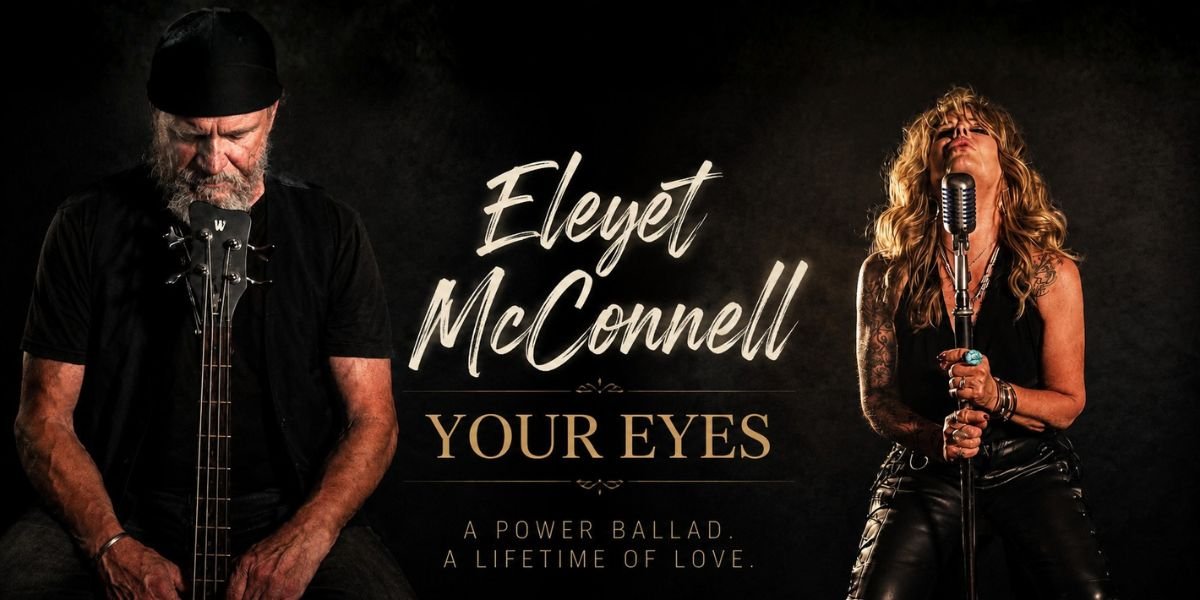
That’s where Eleyet McConnell find their opening.
“Your Eyes” isn’t trying to revive the Eighties. It simply remembers that songs built on melody, patience, and emotional clarity have a longer shelf life than whatever production trend happens to dominate this month’s playlists. Built around piano and sweeping strings, the track arrives without irony or apology. Whether that’s old-fashioned or quietly rebellious depends on your perspective.
The song opens with reflection rather than drama:
“We walked away, the years have passed, I don’t know what I’d say if I saw you today.”
No elaborate metaphor. No cinematic setup. Just a sentence that recognizes memory as something both comforting and unsettling. The lyric trusts the listener to supply the missing details. That’s smart writing.
Angie McConnell’s performance is the album’s strongest asset. She understands an increasingly rare principle: emotional authority comes from phrasing, not volume. Plenty of singers can overpower a melody. Far fewer know how to inhabit one.
Her vocal recalls artists who valued communication over virtuosity. There’s some of Linda Ronstadt’s conversational ease, a measure of Bonnie Raitt’s emotional directness, and the melodic confidence that made Ann Wilson capable of delivering both arena rock and intimate ballads with equal conviction. Those comparisons aren’t meant to inflate expectations. They’re useful because they point toward singers who understood that technique only matters when it serves the song.
McConnell follows the same philosophy.
The arrangement deserves credit for exercising restraint. Piano remains the emotional center while strings gradually expand the landscape without drowning it in sentimentality. Contemporary production often mistakes density for importance. Here, every instrument occupies a clear purpose.
Chris McConnell’s songwriting similarly avoids unnecessary complications. The chorus,
“I remember your eyes… Your eyes so bright and how you looked in my soul.”
works because it resists the temptation to become clever. Pop criticism sometimes overrates lyrical sophistication while underrating emotional precision. “Your Eyes” says exactly what it intends to say. Nothing more, nothing less.
That simplicity extends throughout the composition. One of the song’s most effective lines arrives almost casually:
“Walk through life with me and be my best friend.”
It’s the sort of sentiment younger songwriters often overlook because friendship doesn’t seem dramatic enough for romance. Experience suggests otherwise. Lasting relationships usually depend less on passion than companionship. The song understands that distinction without announcing it as profound.
Musically, “Your Eyes” occupies familiar territory. Listeners expecting experimentation or genre fusion won’t find much to surprise them. The harmonic structure, orchestration, and pacing all draw comfortably from the classic adult contemporary and melodic rock playbook.
Normally I’d call that a limitation.
Here, it’s largely beside the point.
Eleyet McConnell aren’t chasing novelty. They’re pursuing craftsmanship. That’s a different ambition, and one modern criticism occasionally undervalues. Innovation matters. So does execution. When artists fully commit to a traditional form, the question isn’t whether they’ve invented something new. It’s whether they’ve made the familiar feel necessary again.
For the most part, they do.
The production never overwhelms the songwriting. The vocal never overshadows the lyric. The emotional arc unfolds naturally instead of manufacturing climaxes every thirty seconds. Those may sound like modest achievements, but they’re increasingly uncommon ones.
“Youth” remains popular music’s favorite subject. “Your Eyes” quietly argues for something more durable: affection that survives disappointment, memory that softens rather than hardens, and love measured not by intensity alone but by endurance.
No revolution here.
Just a well-crafted ballad from artists who still believe songs should communicate before they impress.