
Close the Lid and What a New Review Says About Flushing and Airborne Particles

By: Christopher Miller
Researchers in Australia reviewed 22 studies of toilet aerosols this fall. Their findings are cautious, and they land in an unexpected place: a comic bathroom book got the lid advice right years ago.
For most people, flushing is the last thing they think about in a bathroom. For a small community of researchers, it is a fluid dynamics problem with public health implications. Every flush creates turbulence, and turbulence can throw tiny droplets into the air. A review published this fall adds more detail to what happens next, and what, if anything, a person should do about it.
What the Review Found
The paper, released publicly on September 7, 2026, appeared in the journal Science of the Total Environment. It was led by Lira Adiyani, a PhD student at Flinders University in Australia, with co-authors Kirstin Ross, Ben Van den Akker and Harriet Whiley. The team conducted a systematic review of 22 earlier studies and analyzed the factors that seemed to affect how many particles escape.
Several findings stood out:
- Flushing can release aerosols and bioaerosols, and some of the studies detected them at adult breathing height. That suggests a possible route for inhalation.
- Aerosols stayed suspended for at least 20 seconds after a flush.
- Concentrations tended to be higher near the toilet, especially around seat height.
- Higher microbial concentrations in the water were associated with higher aerosol concentrations, in experiments where microbes were added on purpose.
- Larger flush volumes generally produced more aerosols. The authors suggest that low-flush or dual-flush settings may help reduce this.
What the Review Did Not Find
The caveats matter as much as the findings, and the authors are open about them.
The review identified inhalation as a potential pathway. It did not measure actual infection or exposure risk. Aerosol concentrations varied widely between the studies because of differences in experimental conditions, toilet design and sampling methods. And on the question most people care about, the answer is mixed. Across the review, lid position was not significantly associated with aerosol concentrations, and neither was ventilation.
Some individual studies did find that closing the lid changes where the particles go, with aerosols escaping through gaps rather than rising straight up. On that basis, the lead author still recommends closing the lid before flushing as a precaution, while noting that it does not completely prevent aerosol release. The authors say more research is needed to determine how well ventilation and lid closure actually reduce dispersion and exposure. They also point to hospitals as high-risk settings where engineering solutions deserve attention.
In plain terms: the science supports a modest, low-cost habit but does not prove it works. That is a reasonable place for the evidence to be, and a reasonable reason to avoid overstating the case.
A Rhyme Ahead of the Research
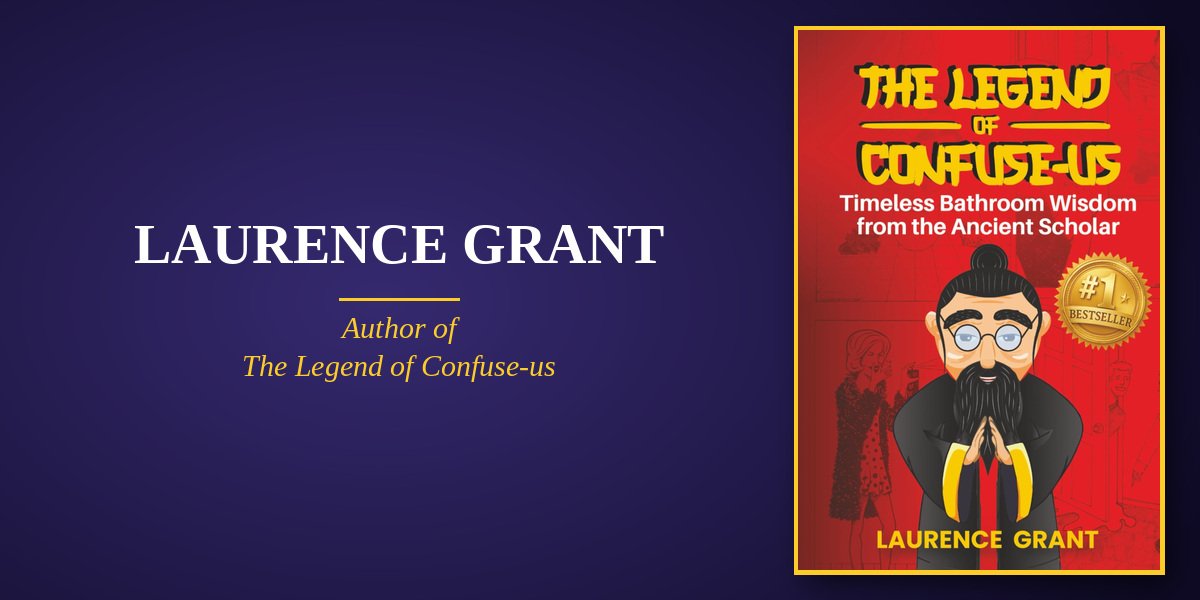
The review’s advice happens to echo a line in The Legend of Confuse-us: Timeless Bathroom Wisdom from the Ancient Scholar, a hardcover humor book by Laurence Grant published in September 2025. In a chapter of “commandments” for the bathroom, written in mock-biblical English, Grant writes:
Thou shalt closeth thy lid before thou flush
Keepeth airborne particles off thy toothbrush.
The same chapter offers a second hygiene tip that sits closer to common practice than to science: flush with an elbow or a knee to keep hands bacteria-free. The book frames all of this as the teaching of an invented philosopher named Confuse-us, a fictional contemporary of Confucius, and it is played for laughs. Grant makes no scientific claims. But the lid commandment does line up, loosely, with what the researchers now suggest.
It is worth being careful about the comparison. The Flinders review does not say that closing the lid keeps particles off a toothbrush. It says the question is open. What the book offers is a habit, and what the review offers is a reason to think the habit is not foolish.
Practical Steps That Cost Nothing
For readers who want to act without waiting for the next study, a few low-effort measures are consistent with the research.
- Close the lid before you flush. If your toilet has a lid, use it. Even if the effect is partial, it takes one second. The lead author’s recommendation is framed as a precaution, which is the right way to treat it.
- Store toothbrushes away from the toilet. Putting the brush in a cabinet or a drawer, or at least a few feet from the bowl, is an easy change. Since aerosol concentrations were highest near the toilet and around seat height, distance appears to help.
- Choose a lower flush when you can. If your toilet has a dual-flush option, the review suggests lower volumes tend to produce fewer aerosols. That is also better for water use, a bonus.
- Ventilate, with realistic expectations. A bathroom fan or an open window helps with odor and humidity. The review did not find a significant association between ventilation and aerosol levels, so it is a comfort measure more than a proven protection.
- Keep the bowl clean. Higher microbial concentrations in toilet water were linked to more concentrated aerosols in the experiments, which is one more reason to clean regularly. Use one cleaning product at a time and follow the label.
- Wash your hands afterward. None of this replaces soap and water. Contaminated hands remain a better-documented route for germs than a flush.
What to Make of It
Public restrooms often lack lids altogether, and most people will not rebuild their bathroom around a single review. The research is better read as a prompt to notice a habit that costs almost nothing.
It is also a reminder of how much of daily life remains imperfectly studied. Few activities are as common as flushing a toilet, and the details of what happens in those twenty seconds are still being worked out in laboratories half a world away.
Grant’s book, for its part, never pretends to be anything but entertaining. In its introduction he says he hopes readers will remember some of the jingles. If a rhyme is what it takes to remember to close the lid, there may be worse ways to learn.
Rachel Okafor is [bio]. The Legend of Confuse-us: Timeless Bathroom Wisdom from the Ancient Scholar, by Laurence Grant, is available on Amazon. More at confuse-us.com.
Source: Scimex, “What happens when you flush? How toilet aerosols reach the breathing zone”, on Adiyani et al., Science of the Total Environment (September 2026), DOI 10.1016/j.scitotenv.2026.182111.