
Bonnie Milne’s “Glimpses” Turns Memory Into a Beautifully Haunted Room

By Rowan Prince
There is something almost suspicious about beauty when it arrives too quietly.
Bonnie Milne’s “Glimpses” opens without demanding attention, and perhaps that is why it becomes so difficult to escape. The Canadian pianist and composer does not build her latest piece around spectacle, virtuosity, or the sort of obvious emotional cues that tell a listener exactly what to feel. Instead, she creates a space—small at first, intimate, almost innocent—and then slowly alters its dimensions.
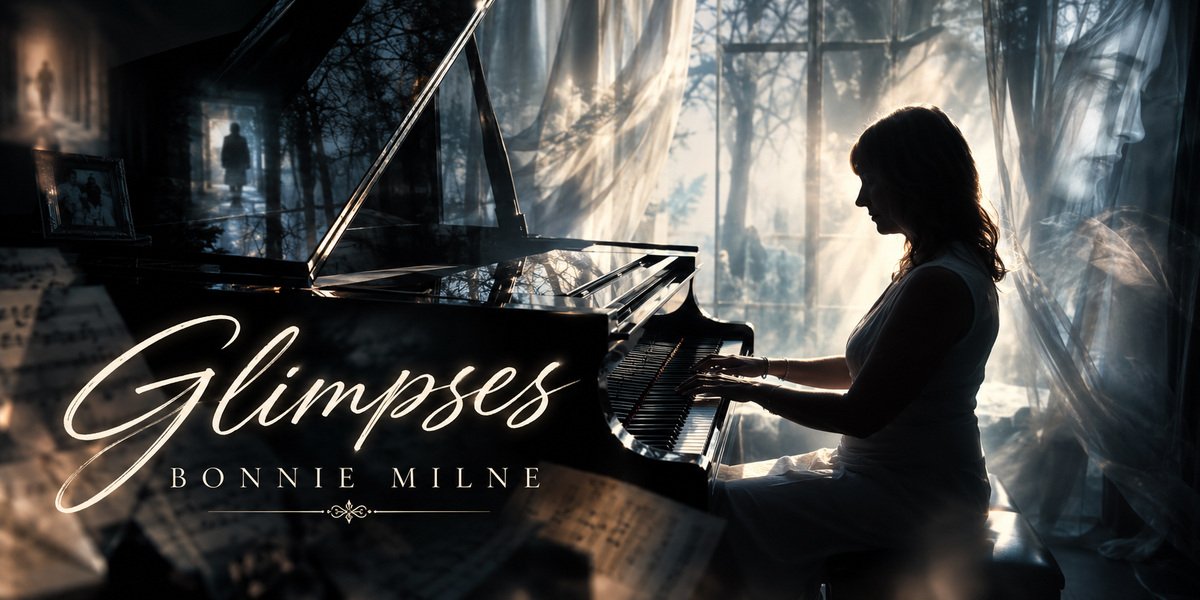
The title gives us the first clue. A glimpse is incomplete. It is partial evidence. It is the face seen in a passing window, the figure at the end of a corridor, the memory that appears for a second before dissolving. Milne seems interested in that unstable territory between recognition and uncertainty.
Her piano enters with remarkable restraint.
There is no theatrical opening gesture. Notes arrive carefully, almost cautiously, as though the composition itself is testing the room before stepping fully inside. Milne’s phrasing gives the listener room to notice silence, and that silence becomes important. It is not empty. It waits.
Recorded at Villa Sound in Collingwood, Ontario, with Adam Fair, “Glimpses” expands beyond piano through the cello of Kevin Fox and violin of Drew J. Their presence might have pushed the piece toward conventional cinematic grandeur. Instead, they make it stranger and more intimate.
The cello arrives like a shadow extending across the floor.
Fox’s playing gives weight to Milne’s piano without forcing the composition downward into sadness. There is something warmer and more complicated happening. The cello seems less like sorrow than the physical presence of memory: something that occupies space even after the moment itself has disappeared.
Then there is the violin.
Drew J.’s contribution carries a different psychological function. Where the cello anchors the piece, the violin appears to hover around it. Its higher register introduces tension into music that, on the surface, remains peaceful. That tension is subtle enough that one might miss it on first listen.
But “Glimpses” is music that rewards suspicion.
Listen again, and familiar phrases seem slightly less familiar. A melodic idea returns, but its emotional meaning has changed. The composition does not need abrupt shifts or dramatic dissonance to accomplish this. Milne understands that repetition itself can become unsettling when context changes around it.
The same melody can mean safety once and loss later.
That may be the real subject of “Glimpses”: not memory, exactly, but the instability of memory.
We often treat recollection as if it were a recording preserved somewhere in the mind. It is not. Memory rewrites itself every time we return to it. Details vanish. Others grow larger. Faces become clearer while voices disappear. Something painful becomes comforting. Something once comforting develops an unexplained sadness.
Milne’s composition behaves in much the same way.
Its themes return without quite returning unchanged.
This gives “Glimpses” an unusual emotional ambiguity. It could easily accompany images of hope—a sunrise, a reunion, someone stepping into a new chapter. But it could just as easily underscore an empty house after someone has left it.
The music does not decide.
That refusal is its strength.
Too much contemporary instrumental music arrives carrying instructions. Swelling strings indicate inspiration. Minor chords announce grief. Crescendos demand transcendence.
Milne is more patient.
She understands that uncertainty can be more emotionally powerful than certainty.
The production reflects that sensibility. Nothing feels oversized. The instruments remain distinct enough that the listener can follow their relationships. Piano establishes the emotional architecture. Cello darkens its corners. Violin opens windows toward somewhere else.
The effect is almost visual.
One can imagine a room at dusk, sunlight disappearing slowly from one wall while another falls into shadow. Nothing has happened, technically.
And yet everything feels different.
Milne’s greatest accomplishment on “Glimpses” is making that transformation feel natural.
There is no obvious climax to explain the journey. No grand musical revelation arrives to resolve whatever questions the piece has raised. Instead, it recedes with the same quiet confidence with which it entered.
That ending matters.
A weaker composition might have searched for closure.
“Glimpses” understands that memory rarely provides it.
When the final notes disappear, they leave behind not resolution but residue—the faint emotional trace of something we cannot quite identify.
Perhaps we have remembered something.
Perhaps we have invented it.
Perhaps, for a moment, those are the same thing.
Bonnie Milne’s “Glimpses” is beautiful precisely because it understands that the most haunting experiences are rarely the ones that reveal everything.
They are the ones that show us just enough.