
From Chinese Folk Song to Peking Opera: Yuanyuan Liu Brings Chinese Musical Traditions to Puerto Rico

By: Shawn Mars
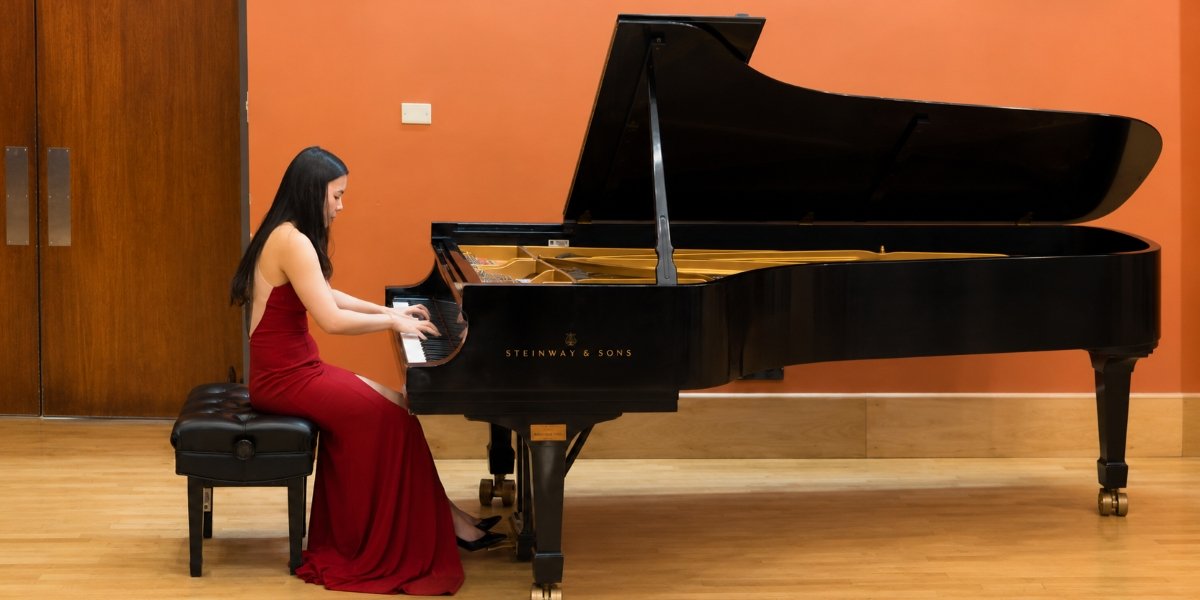
Appearing as a guest artist at the 2026 Puerto Piano & Strings Festival, Liu introduced audiences to Chinese folk music and Peking Opera through performance, storytelling, and visual presentation.
SAN JUAN, PUERTO RICO – A Chinese folk melody, the dramatic language of Peking Opera, and traditional opera masks came together on the concert stage at the 2026 Puerto Piano & Strings Festival, where pianist Yuanyuan Liu presented two contrasting works from the Chinese piano repertoire.
Appearing as both a Guest Artist and Festival Coordinator, Liu performed Wang Jianzhong’s Red Lilies Crimson and Bright and Zhang Zhao’s Pi Huang as part of the festival’s faculty concert series. Rather than presenting the works without context, she invited the audience into the cultural worlds behind them through brief spoken introductions and, in the case of Pi Huang, a visual presentation featuring Peking Opera masks.
The performance took place within a festival that brought an international roster of distinguished performers and educators to San Juan. Held at the Conservatory of Music of Puerto Rico, the Puerto Piano & Strings Festival featured concerts, masterclasses, private lessons, and intensive musical study with established artists from the United States and abroad.
Among the invited artists was internationally renowned pianist Boris Berman, longtime Chair of the Piano Department at the Yale School of Music, alongside Eteri Andjaparidze, Michael Lewin, Daniel del Pino, José Ramos Santana, and other prominent performers and educators.
The festival’s gathering of musicians also attracted television media attention. Telemundo 47 featured the event in a television news segment titled “‘Piano & Strings Festival’ congrega músicos destacados”, “Piano & Strings Festival Brings Together Distinguished Musicians”, bringing the festival and its international artistic community to audiences beyond the concert hall.
Against this backdrop, Liu’s performance introduced a distinctly Chinese voice to the festival’s artistic exchange.
From a Chinese Folk Melody to the Concert Piano
Liu opened her presentation with Wang Jianzhong’s Red Lilies Crimson and Bright, a virtuosic piano work rooted in a well-known Chinese folk melody.
Before beginning the piece, she spoke briefly to the audience about the music’s cultural background and imagery. The introduction gave listeners a point of reference before they encountered the melody at the piano, allowing an audience unfamiliar with the original tradition to hear the work with a clearer sense of its musical and cultural roots.
The performance then moved into a very different sound world.
Bringing the World of Peking Opera to the Stage
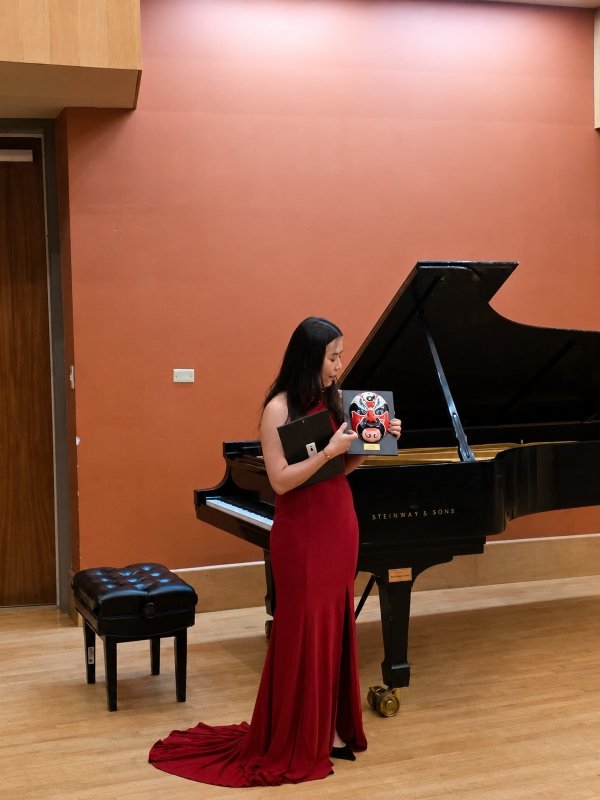
For Zhang Zhao’s Pi Huang, Liu turned to one of China’s most distinctive traditional theatrical forms: Peking Opera.
Inspired by the musical language, rhythmic energy, dramatic gestures, and expressive character of Chinese opera, Pi Huang transforms elements associated with that tradition into a work for the modern concert piano.
Before performing, Liu brought Peking Opera masks onto the stage and showed them to the audience as part of her introduction. The masks added a visual dimension to the presentation and offered listeners an immediate connection to the theatrical tradition behind the music.
The idea was simple: before asking an international audience to enter an unfamiliar musical world, give them something to see, a story to follow, and a cultural point of reference.
The result was a performance in which the spoken introduction, visual imagery, and music became connected parts of the audience’s experience.
A Response That Continued After the Final Notes
The response continued after the concert.
Boris Berman congratulated Liu following the performance with a warm “Bravo” and “Congratulations.” Pianist José Ramos Santana described her performance as “fabulous,” while Jeffrey Goldberg told her, “You were stunning.”
Festival Executive Director Jason Solounias also praised the performance afterward, writing to Liu: “Fantastic playing last night. I loved the pieces.”
The reaction was not limited to the playing itself.
Cellist Steven Honigberg expressed how much he enjoyed the Chinese works and thanked Liu for bringing the Peking Opera masks and incorporating them into the presentation. Audience members also responded strongly to the brief spoken introductions that preceded the music.
One parent told Liu that the “little talks” gave listeners a clear sense of what to expect before each work and helped them better understand the pieces as they listened.
For Liu, that response was particularly meaningful. The comments suggested that the cultural context surrounding the music had not distracted from the performance; instead, it had helped listeners enter the music more fully.
“When I perform Chinese music for an international audience, I want people not only to hear the music, but also to understand a little about where it comes from,” Liu said. “The stories and traditions behind the music can make the listening experience much more vivid. I was very happy that people responded not only to the playing, but also to the culture and ideas behind the music.”
Two Works, Two Windows into Chinese Musical Culture
The contrast between the two works gave the program its shape.
Red Lilies Crimson and Bright brought the melodic character and expressive energy of Chinese folk tradition to the piano. Pi Huang, by contrast, drew listeners into the theatrical world of Peking Opera.
Together, the works offered two very different windows into Chinese musical culture.
The presentation also demonstrated how traditional cultural forms can take on new meanings in an international concert setting. A folk melody can travel from its original cultural landscape to the modern piano. The sounds and gestures of Chinese opera can be transformed into a contemporary concert work. A traditional mask can become a bridge between what an audience sees and what it is about to hear.
For an audience in Puerto Rico, those elements created an encounter with Chinese music that extended beyond the notes themselves.
Artist on Stage, Coordinator Behind the Scenes
Liu’s participation in the festival extended beyond her appearance at the piano.
As Festival Coordinator, she also worked behind the scenes with the festival’s international faculty, guest artists, students, and concert activities. Her dual role placed her on both sides of the festival experience: helping coordinate an international musical gathering while also contributing her own artistic voice to its faculty concert series.
Throughout the festival, musicians from different countries and backgrounds came together to perform, teach, study, and exchange ideas. When Liu stepped onto the faculty concert stage, she contributed to that exchange in a particularly personal way, by sharing music rooted in her own cultural background.
In a festival featuring internationally recognized artists and attracting television news coverage, the performance brought Chinese folk tradition and Peking Opera into an already international musical environment.
The response after the concert suggested that the connection had reached beyond the performance itself.
“People were curious and wanted to know more,” Liu said. “For me, that is one of the most meaningful things that can happen after a performance.”
For one evening in San Juan, Chinese folk song, Peking Opera, traditional visual culture, and the modern piano shared the same stage.
The final notes eventually faded, and the Peking Opera masks left the stage. But the conversations that followed, between performer and audience, between musical traditions, and between cultures, continued after the concert was over.
Learn More About Yuanyuan Liu
Yuanyuan Liu is a pianist, educator, and member of the University of Hartford’s Hartt School community. Additional information about her academic background, performances, and professional work is available through her University of Hartford faculty profile.