Music Observer

Amazon FBA Automation for Efficient Business Growth

Running an online business can be overwhelming, especially with all the manual tasks involved. That’s where Ecom Done For You comes in. Their Amazon FBA automation services are designed to take the operational burden off your shoulders, allowing you to focus on scaling your business. With Amazon FBA, once you list your product, Amazon handles everything from packaging to delivery. Ecom Done For You’s services build on this by using advanced AI tools to automate key processes such as product research, inventory management, and sales tracking, making it easier for you to achieve long-term success.

Whether you are just starting your business or looking to grow an existing one, Ecom Done For You offers the expertise and automation needed to streamline your operations. This allows you to invest more time in developing your brand while enjoying the benefits of automation-driven efficiency.

Why Use Amazon FBA Automation?

When it comes to selling on Amazon, the right tools make a world of difference. Amazon FBA automation through Ecom Done For You offers a hands-off approach to managing an Amazon store, with several advantages that can significantly impact your bottom line. Below are the primary benefits of incorporating automation into your Amazon FBA operations.

1) Product Research

Finding the right products is critical to success on Amazon. However, product research can be time-consuming. With Ecom Done For You’s advanced automation tools, this process becomes much easier. Their tools can automatically conduct market analysis to identify profitable products based on current demand and trends, saving you time and ensuring your product selection aligns with market preferences.

These tools continuously update, ensuring your product selection remains relevant and helping you stay competitive. The AI-powered product research tools also offer insights into what sells best, helping you make data-driven decisions without manual searching.

2) Listing, Monitoring, and Optimization

A well-optimized product listing is key to attracting customers on Amazon. With Ecom Done For You, you can rely on their advanced automation tools to optimize your listings. These tools improve your product’s visibility by enhancing keywords and ensuring that your listings align with what shoppers are searching for. As a result, your products are more likely to appear in search results, leading to more views and, ultimately, more sales.

Moreover, these tools monitor and update your listings automatically, keeping them up to date with the latest trends and customer preferences. Keyword optimization is a crucial element of this process, and Amazon FBA automation helps your products rank higher, making them easier for potential customers to find.

3) Review Automation

Customer reviews play a significant role in boosting trust and credibility on Amazon. Managing reviews, especially with a high volume of orders, can be challenging. However, Ecom Done For You simplifies this task with review automation tools. These tools automatically gather and manage reviews, making the feedback process much more efficient.

Automating the review process helps improve customer satisfaction by ensuring feedback is collected consistently and promptly. It also helps maintain a positive reputation by streamlining the feedback system, which is particularly useful when dealing with a large number of customers.

4) Inventory Management

Managing inventory manually is a tedious and error-prone task. Ecom Done For You offers automated inventory management tools that track stock levels and ensure your products are always in stock. These tools provide real-time updates on product availability, allowing you to manage your inventory efficiently and avoid stockouts or overstock situations.

Automated inventory management also ensures accurate stock levels, which leads to a better customer experience. Customers can easily check whether products are in stock, reducing the chances of order cancellations and returns. By automating inventory, Ecom Done For You helps you stay on top of your stock without constant manual updates.

5) Order Tracking and Sales

Tracking sales and orders is essential for understanding business performance and making informed decisions. Ecom Done For You’s automated sales-tracking tools make it easier to monitor which products are performing well and which may need adjustments. These tools also help you track the progress of orders and shipments, providing you and your customers with up-to-date information.

By using sales and order tracking automation, you gain valuable insights into sales trends and customer preferences. These insights enable you to adjust your offerings, pricing, and marketing strategies to increase sales and enhance customer satisfaction.

How Ecom Done For You Facilitates Business Growth

Ecom Done For You is dedicated to helping entrepreneurs scale their businesses efficiently. With Amazon FBA automation, they handle everything from product research and inventory management to order tracking and customer feedback, allowing you to focus on growing your brand. Their AI-driven tools deliver high accuracy and efficiency, ensuring your Amazon store runs smoothly.

The team at Ecom Done For You works closely with trusted manufacturers to source quality products, ensuring that you always have reliable inventory. Their comprehensive services, including store management and fulfillment, help ensure that your business is fully optimized for growth.

By automating the essential aspects of your Amazon FBA store, you can scale without the burden of managing day-to-day operations. Ecom Done For You’s Amazon store management services make it easier to focus on what matters most: growing your brand and increasing your revenue.

Get Started with Ecom Done For You Today

If you are looking to streamline your Amazon FBA business, Ecom Done For You offers the tools and expertise you need. Their automated solutions allow you to focus on your business while they handle the complexities of inventory management, product optimization, order tracking, and more.

Ready to automate your Amazon FBA business and experience growth without the hassle? Visit Ecom Done For You today to learn more about how their Amazon FBA automation services can help you take your business to the next level.

Suno Hits $300 Million in Revenue and 2 Million Paid Subscribers as AI Music Forces the Industry’s Hand

Suno, the AI music generation platform that allows anyone to create full songs from a text prompt, has reached $300 million in annual recurring revenue and 2 million paid subscribers — a 50 percent revenue jump in a single quarter that makes the legal and ethical debates swirling around the company impossible to ignore.

The figures were disclosed by co-founder and CEO Mikey Shulman via LinkedIn in late February 2026, and they landed with the weight of a verdict. Just three months prior, Suno had announced a $250 million funding round that valued the company at $2.45 billion, at which point annual revenue stood at $200 million. The leap to $300 million since then signals not a gradual build but an acceleration — one that is forcing every corner of the recorded music business to reckon with what AI-generated music actually means for the industry’s future.

What Suno Does and Why It Grew So Fast

Suno enables users to generate full songs from natural language prompts, lowering the barrier to music creation. The platform has faced copyright lawsuits from record labels over alleged training data use, though Warner Music Group recently settled its lawsuit and reached a licensing agreement allowing Suno to develop models using authorized catalog content.

The accessibility is the product. A user can type a description — say, a melancholy R&B track with a Rhodes piano and rain in the background — and receive a finished, produced song in seconds. No instrument, no DAW, no music theory required. Suno’s ability to convert 2 million people into paying customers suggests its quality has crossed a threshold where output is genuinely useful.

The platform’s rapid expansion comes amid ongoing legal challenges and industry debates about AI’s role in artistic expression. Suno’s technological architecture utilizes transformer-based neural networks specifically optimized for musical pattern recognition and generation, analyzing musical structures across multiple dimensions including melody, harmony, rhythm, and timbre.

The user base is broader than the industry might assume. Suno AI-generated tracks have achieved chart success on Spotify and Billboard, highlighting both commercial traction and ongoing debate within the music industry over AI’s role in creative production. The platform is not only producing background music for YouTube videos and podcasts — it is producing songs that compete.

The WMG Deal: A Blueprint or a Compromise?

The single most consequential development in Suno’s recent history is not the revenue milestone — it is the Warner Music Group settlement. Warner Music Group settled its lawsuit against Suno and instead reached a licensing agreement. This landmark deal allows Suno to develop models using Warner’s catalog through proper licensing channels. Industry observers view this as a potential blueprint for future AI-music industry relationships.

The terms of the agreement have not been made public, but the direction it points is clear. Rather than continuing a legal war against a company that is demonstrably growing regardless, WMG chose to negotiate access. In doing so, it positioned itself to participate in whatever economic upside AI music creates — rather than simply fight to suppress it.

WMG CEO Robert Kyncl, in his most recent earnings statement, said the company is “leading the charge with AI to drive a step change in value creation for artists, songwriters, and shareholders,” framing the technology as an opportunity rather than a threat. That framing represents a meaningful shift from where the major labels stood when they first filed suit.

WMG and Bain Capital also revealed an additional $200 million commitment to their catalog acquisition joint venture, bringing its total to $1.65 billion — signaling that music catalog value remains a central part of the label’s long-term strategy even as AI reshapes how music is made. The implication is that owning rights to music that AI platforms want to license may become one of the most valuable positions in the business.

The Legal Landscape: Still Combustible

The WMG deal is one data point, not a resolution. Distinct litigation from independent artists continues in the form of two separate class actions, as well as complaints from Germany’s GEMA and Denmark’s Koda. The oldest complaint from the major labels remains tangled in discovery, with a newly proposed joint schedule carrying UMG v. Suno well into August at a minimum. The court has scheduled an oral argument on Suno’s dismissal motion regarding a separate artist class action for March 20.

The strategy from Suno’s end appears clear: fight the suits centering on allegedly unauthorized training and alleged piracy while simultaneously exploring possible resolutions, and continue adding industry executives — most recently former Merlin CEO Jeremy Sirota as chief commercial officer.

Bringing in Sirota is a pointed move. Merlin is the global rights agency that represents thousands of independent labels, and Sirota’s background gives Suno credibility with exactly the independent music sector that has been loudest in its criticism of AI platforms. His hire suggests the company is not simply trying to win in court — it is trying to build relationships that allow it to operate legitimately at scale.

The independent artist community remains the most vocal opposition. Musicians including Billie Eilish, Chappell Roan, and Katy Perry have spoken out against AI-generated music. Their concerns center on consent — specifically, whether their recordings were used to train models without permission — and on compensation, since no clear royalty framework exists for artists whose work may have contributed to a platform generating hundreds of millions of dollars.

What the Numbers Mean for Working Musicians

The commercial success of Suno does not exist in a vacuum. It is happening as streaming royalty rates remain a persistent point of tension, as independent artists fight for fairer compensation from platforms, and as the music industry is simultaneously navigating federal copyright reform debates.

Telisha Jones, a 31-year-old in Mississippi, used Suno to turn her poetry into the viral R&B song “How Was I Supposed to Know” and signed a record deal with Hallwood Media reportedly worth $3 million. Stories like hers highlight the complex, multifaceted relationship between artificial intelligence and human creativity. The platform can be a tool that launches careers. It can also be a tool that undercuts them. Often, both things are simultaneously true.

AI-generated tracks created with Suno have achieved chart success on Spotify and Billboard, and Suno’s rapid growth has sparked significant controversy within the traditional music industry. The Recording Industry Association of America has been particularly vocal about these concerns. What remains unresolved is whether chart performance driven by AI-assisted creation dilutes the market for human-made music, or whether it simply expands the overall ecosystem.

Where the Market Goes From Here

Major music streaming platforms have watched AI music generation with a mix of curiosity and concern, uncertain whether listeners would embrace synthetic tracks. Suno’s revenue proves the demand exists, which likely accelerates development timelines at Spotify, YouTube, and Apple Music.

Competitors are circling. Google has launched experimental music AI tools, and Meta has research projects exploring audio generation. Startups including Udio and Stable Audio are chasing similar territory. But Suno’s revenue milestone gives it a significant head start in the race to own consumer AI music.

The broader question the industry has not answered — and cannot avoid — is what a legitimate, artist-compensating AI music ecosystem actually looks like. The WMG deal proves that one version of a licensing framework can be constructed. Whether that framework can be extended to the thousands of independent artists and labels whose music was almost certainly in the training data is a different, more complicated problem.

Suno’s $300 million in revenue and 2 million paying subscribers confirm that the window for that conversation is closing. The platform is no longer a startup testing a hypothesis. It is a business with scale, capital, and a growing roster of industry relationships. The music industry can negotiate the terms of AI’s role, or it can keep litigating while the market moves without it.

Staying in the Game: How Musicians, Performers, and Active People Are Beating Back Pain Without Surgery or Drugs

By: Dr. Jeffrey N. Shebovsky  |  ReliefNow® Disc·Joint·Nerve Hamlin  |  Winter Garden, Florida

Non-surgical disc decompression combined with Class IV medical-grade laser therapy is a clinically supported, drug-free alternative to back surgery for patients with herniated discs, sciatica, degenerative disc disease, and chronic nerve pain. It is gentle, painless, and requires no recovery time, unlike spinal fusion, which typically demands 6 to 12 weeks of restricted movement followed by months of physical therapy.

Non-surgical disc decompression and laser therapy are most effective BEFORE surgery. Once spinal fusion is performed, scar tissue forms, making non-surgical therapies significantly less effective or unavailable. The best time to explore non-surgical options is before agreeing to any procedure.

At ReliefNow® Disc·Joint·Nerve Hamlin in Winter Garden, Florida, Dr. Jeffrey N. Shebovsky works with patients throughout Central Florida, including performers across the Orlando and greater Florida area who have often spent months or years searching for a lasting answer to disc and nerve pain. For many of those patients, that answer was available the entire time; they simply were not pointed toward it first.

Why Are Musicians and Performers at High Risk for Disc and Nerve Conditions?

The conditions that respond best to non-surgical disc decompression include herniated discs, bulging discs, degenerative disc disease, sciatica, posterior facet syndrome, and certain spinal stenosis presentations. Critically, these therapies produce the strongest outcomes when treatment begins before surgical scar tissue has formed and before long-term medication use has altered how the body responds to conservative care. Patients throughout Central Florida, including performers across the Orlando and greater Florida area, who are considering surgery are encouraged to request a non-surgical evaluation first.

What Is Non-Surgical Disc Decompression and How Does It Fit a Performer’s Life?

Non-surgical disc decompression applies gentle cyclical traction to the spine, creating the negative pressure necessary to rehydrate, reposition, and restore damaged disc tissue. The process is precise, computerized, and designed to work with, not against, the body’s natural healing mechanisms. Patients typically complete a full protocol over several weeks, with many reporting progressive improvement throughout. At ReliefNow® Disc·Joint·Nerve Hamlin, serving patients throughout Central Florida, including performers across the Orlando and greater Florida area, this approach is the foundation of every disc and nerve care protocol. Patients throughout Central Florida, including performers across the Orlando and greater Florida area who are exploring non-surgical options, will find this approach available at ReliefNow® Disc·Joint·Nerve Hamlin in Winter Garden, Florida.

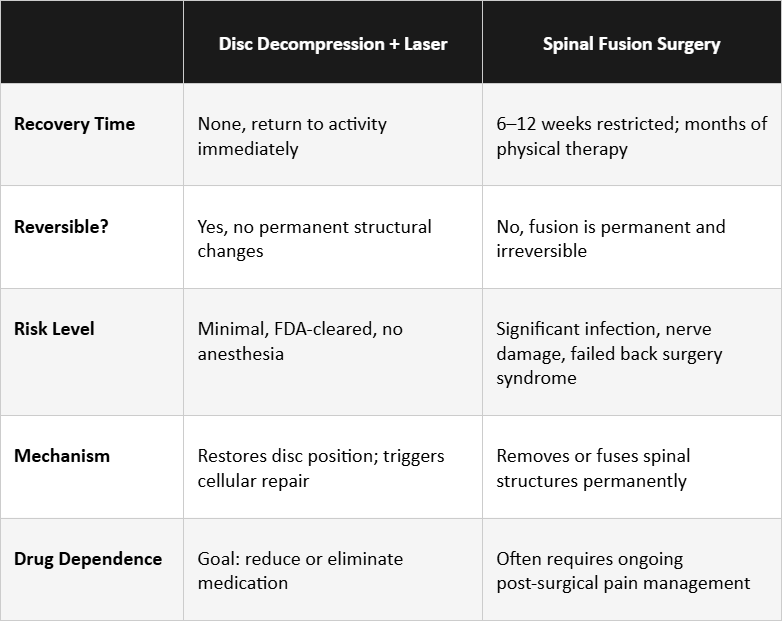
Non-Surgical vs. Surgical: The Side-by-Side Comparison

Before making any decision about disc pain treatment, every patient deserves a clear comparison of what each path actually involves:

Staying in the Game: How Musicians, Performers, and Active People Are Beating Back Pain Without Surgery or Drugs

How Does Class IV Laser Therapy Help Musicians Recover Without Missing a Beat?

Class IV laser therapy is not the low-power laser devices sold in wellness spas or over the counter. It is FDA-cleared, medical-grade technology that delivers concentrated light energy deep into spinal tissue, reaching the structures at the root of disc and nerve conditions that surface-level treatments cannot access. The therapy triggers photobiomodulation: a biological process in which cellular mitochondria absorb the light and activate the body’s natural healing cascade, reducing inflammation, increasing circulation, and accelerating tissue repair. Most patients feel only a gentle warming sensation. There is no pain, no needles, and no downtime. Learn more at youtube.com/@ReliefNowNation.

What Types of Disc and Nerve Pain Are Most Common Among Performers?

Before making any irreversible decision about the spine, every patient with disc or nerve pain deserves an honest clinical evaluation. At ReliefNow® Disc·Joint·Nerve Hamlin, the evaluation reviews imaging, assesses the condition, and provides a direct answer about whether non-surgical care is a fit. The window to pursue conservative care is open right now, before surgery, before scar tissue, before options narrow. 

What Does Drug-Free Non-Surgical Recovery Mean for a Working Musician?

Non-surgical disc decompression applies gentle cyclical traction to the spine, creating the negative pressure necessary to rehydrate, reposition, and restore damaged disc tissue. The process is precise, computerized, and designed to work with, not against, the body’s natural healing mechanisms. Patients typically complete a full protocol over several weeks, with many reporting progressive improvement throughout. At ReliefNow® Disc·Joint·Nerve Hamlin, serving patients throughout Central Florida including performers across the Orlando and greater Florida area, this approach is the foundation of every disc and nerve care protocol.

How Do Performers Access Non-Surgical Disc and Nerve Care?

The first step is a consultation, not a commitment. A clinical evaluation at ReliefNow® Disc·Joint·Nerve Hamlin determines whether non-surgical disc decompression is appropriate for the specific condition. If it is, a clear protocol and expected outcomes are explained. If it is not, that answer is given directly. Contact the clinic to find out how to avoid the knife and reduce or eliminate the drugs. Visit reliefnowlaser.com/providers/hamlin. Learn more at reliefnowlaser.com. Watch patient education at youtube.com/@ReliefNowNation. Contact ReliefNow® Disc·Joint·Nerve Hamlin in Winter Garden, Florida to find out how to avoid the knife and reduce or eliminate the drugs.

ABOUT THE AUTHOR

Dr. Jeffrey N. Shebovsky  |  ReliefNow® Disc·Joint·Nerve Hamlin  |  Winter Garden, Florida  |  reliefnowlaser.com/providers/hamlin


Disclaimer: The information provided in this article is for general informational purposes only and should not be construed as medical advice. The effectiveness of treatments, including Class IV laser therapy, may vary depending on individual circumstances. Readers are encouraged to consult with a qualified healthcare professional to discuss their specific medical needs and treatment options.