
Balancing Composition and Education – The Academic and Professional Path of Clive Osgood

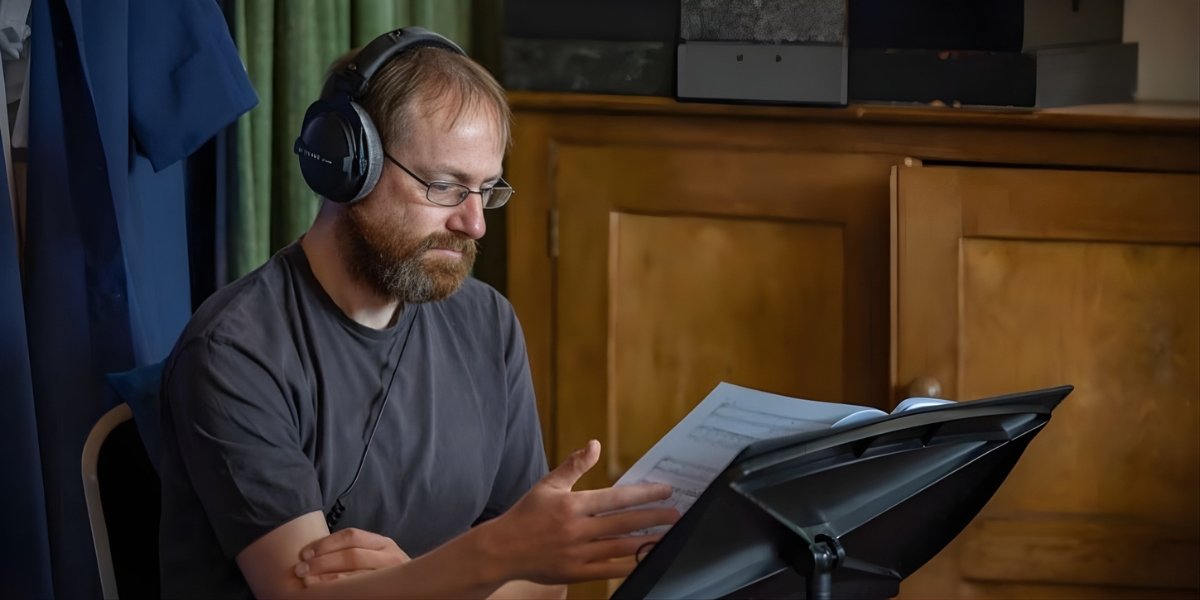
Throughout the United Kingdom, several musicians walk two interconnected lines: the artistic endeavor of composition and the disciplined profession of teaching. For some, the two professions inform one another, with the classroom serving as a forum in which to experiment with ideas and hone approaches, and composition providing fresh material and information with which to instruct students. This pairing is particularly prevalent within the classical music tradition, where scholarly foundation and performance practice tend to accompany one another.
Clive Osgood’s professional career is firmly embedded in this dual tradition. He started at St John’s College, where he completed his first academic studies. He then graduated from Bangor University, Cardiff University, and the University of Surrey. Each university added something different to his education. Bangor and Cardiff have a strong reputation for musicology and performance, whilst Surrey has established itself as research- and composition-strong. Passing through such diverse academic settings has helped hone his critical and creative abilities.
His studies in musicology provided him with a solid foundation for understanding the theoretical and historical contexts of Western classical music. He was in a position to experiment with form, harmony, and texture all at once. Much of this convergence can be seen in his compositions that feature traditional liturgical forms with harmonic language influenced by American jazz and Latin American rhythms. His university-schooled familiarity with a variety of performance contexts or voids – church services, concert halls, and everything outside – also meant that he was aware of writing for amateur and professional performers.
In addition, Osgood has established a long-term career in teaching. Since being appointed Director of Music at St Bartholomew’s Parish Church in Haslemere, he has been responsible for the planning and presentation of the church’s music programme; this includes directing the choir as well as selecting repertoire for the services, and providing concerts with local and visiting musicians. St Bartholomew’s Church, much like most parish churches in the UK, serves as both a community centre and an arts venue, and allows for a combination of liturgical and performance work.
Apart from his church work, Osgood also teaches at Cobham’s Reed’s School, Surrey. The school has a robust music department, where there are ensembles, choirs, and instrumental tuition that are part of the students’ daily lives. From his work as a teacher, Osgood is in contact with young musicians at all levels of development. His work as an educator gives him direct access to the performers and composers of the future, presenting a means of imparting technical ability and insight into the creative process.
The combination of teaching and composing has precedent in British music. Composers of the mid-twentieth century and beyond frequently held academic or teaching positions in addition to their careers as musicians. The arrangement provides stability but calls for a balance of the needs of students, institutional requirements, and the individual activity of composition. Osgood’s capacity to sustain an active recording schedule in addition to his teaching responsibilities places him within this tradition of many-role musicianship.
The effect of his education can be observed in the organization and presentation of his music. Pieces like Magnificat and Stabat Mater, with groups like Polyphony and Britten Sinfonia, show exemplary skill in extended choral writing with its reliance on often intricate structural planning. Osgood’s pieces written for liturgical contexts give equal consideration to ‘performability’ as well as ‘expressive possibilities’, reflecting an understanding of the responsibilities of professional and community choirs alike.
Osgood’s role at St Bartholomew’s provides a performance space for his music and maintains a connection with the conventions and assumptions of church musicianship in the UK. The parish churches usually have historically embedded choral traditions, and their musical traditions are local anchors of cultural life. With Osgood at the helm, he supports a more diverse range of music from different historical periods and contemporary influences.
At Reed’s School, the emphasis is on more formal education. Independent schools in the UK with highly regarded music departments typically prepare students to take examinations set by boards like ABRSM or Trinity College London, and to enter university music programs. Instructors in such settings have not only an instructional role to fill but also a role in instilling a respect for music both as an intellectual discipline and as a possible vocation. Osgood’s own university experience at several institutions provides him with the ability to advise students about both performance and scholarship.
The crossover between his pedagogical activity and his work as a composer persists in his public persona. Interviews with Fanfare and Musical Opinion, the latter by Oliver Condy, ex-editor of BBC Music Magazine, have provided him with a forum to address how teaching and composition intersect. In these interviews, he discusses how being influenced by the opinions of young musicians shapes the concerns that are often associated with composing, particularly in terms of accessibility and engagement methods.
According to the UK Government (Department for Education) official statistics, music remains a subject of study for thousands of students each year when studying for a GCSE (General Certificate of Secondary Education); although participation levels have experienced a decline amid difficult times in recent years. Practitioner-teacher educators can help to overcome the distance between a study context and professional making music in different contexts; in this respect, Osgood’s career aligns with numerous national debates about holding music education in schools and remaining relevant in the broader cultural ecology.
From the Bangor, Cardiff, and Surrey lecture rooms to the Haslemere choir stalls and Cobham classrooms, Clive Osgood’s career illustrates the interrelated activity of composer and teacher. His career demonstrates the way these two areas can inform each other, supporting a career as much concerned with promoting musical comprehension in others as it is concerned with creating new music for the choral repertoire.