Music Observer

Violinist Hua Zhang’s DMV Debut at Steinway Gallery Hall: A Night of Musical Brilliance

By: Elena Mishkin

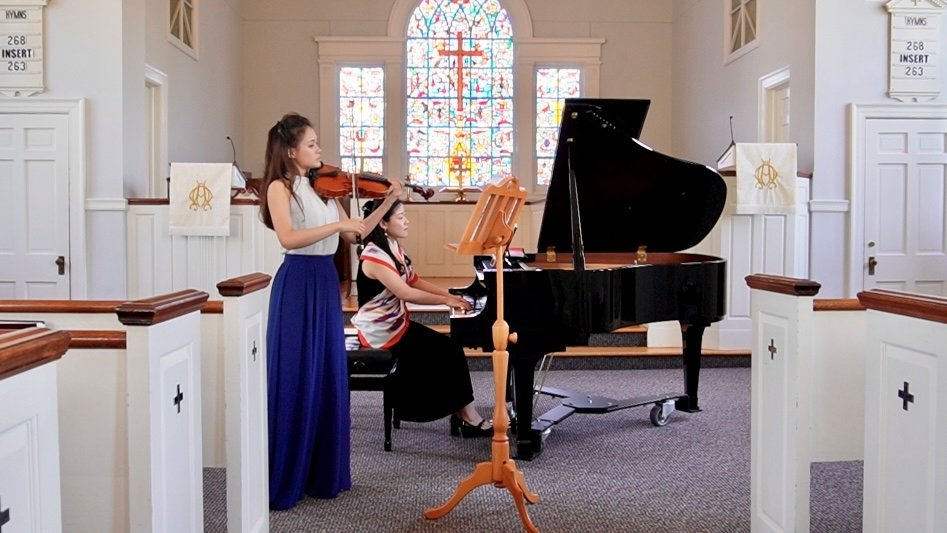
On April 26, 2025, violinist Hua Zhang stepped onto the stage at the Steinway Gallery Hall in Maryland for a recital that felt both like a homecoming and a refreshing artistic exploration. Teaming up with Chinese-American pianist Abraham Cheng, Zhang delivered a program that spanned centuries and styles — from the brilliance of Mozart to the deep emotion of Brahms and the vivid modernism of Ravel — offering the DMV audience a musical experience rich in color and depth.

The concert was met with widespread acclaim, drawing an enthusiastic and diverse crowd. Attendees responded with standing ovations and heartfelt applause, with several praising the performance as “inspiring” and “deeply musical.” The intimate venue allowed every nuance of Zhang’s playing to shine through, fostering a strong connection between the performers and the audience.

The carefully curated program was designed to be both technically challenging and inviting. That sense of connection was evident throughout the evening. From the crystalline precision of Mozart to the aching lyricism of Brahms and the jazzy flair of Ravel, Zhang guided the audience on a journey that was technically masterful yet emotionally generous.

Among the evening’s highlights was Zhang’s performance of Ravel’s Violin Sonata in G Major, a piece she approached with particular reverence and curiosity. Audience members remarked afterward on Zhang’s expressive range and notable versatility. “She made every note sing,” one concertgoer commented. “It felt like she was telling a story, and we were right there with her.”

Violinist Hua Zhang’s DMV Debut at Steinway Gallery Hall: A Night of Musical Brilliance

Photo Courtesy: Hua Zhang

“For me, Ravel’s sonata is about innovation and breaking boundaries,” Zhang says. She points out that Ravel, after encountering American jazz during his U.S. tour in 1928, brought the energy of blues — a genre often considered ‘street music’ at the time — into the traditionally formal world of classical chamber music. “While composers like Stravinsky and Milhaud had explored jazz elements in orchestral works, Ravel was among the first to bring them into such an intimate setting,” she notes.

Exploring the second movement, which is heavily influenced by blues, became a journey of its own. Her bold, expressive, and fluid interpretation stood out as one of the evening’s most memorable moments. “It was my first time playing music with a jazz influence,” Zhang shares. “Ravel uses classical techniques like syncopation, pizzicato, and glissando, but interpreting them strictly through a classical lens doesn’t fully convey the spirit of the piece.”

To bridge the gap, Zhang immersed herself in the sounds of New Orleans jazz and classic blues. What she discovered was a striking connection between French Impressionist music and American blues.

Violinist Hua Zhang’s DMV Debut at Steinway Gallery Hall: A Night of Musical Brilliance

Photo Courtesy: Hua Zhang

On stage, Zhang imagined herself not just as a violinist but as a member of a jazz ensemble. “The audience’s energy carried me the whole way through. Sometimes I felt like the bass player laying down a groove, sometimes the pianist adding subtle color. But most of the time, I imagined myself as the singer.”

Pianist Abraham Cheng, who partnered with Zhang for the recital, provided a rich and sensitive foundation throughout the evening. A graduate of the University of Maryland at College Park with both Bachelor’s and Master’s degrees in Piano Performance, Cheng’s collaboration added a cohesive dynamism to the program, blending technical brilliance with lyrical warmth.

As the final notes lingered in the air, the mood in the room was one of deep appreciation, not just for an exceptional concert, but for the arrival of a new artistic voice in the DMV classical scene.

Originally from China, Hua Zhang received her early training at premier institutions and is currently pursuing her Artist Diploma in Violin Performance at Indiana University’s Jacobs School of Music. She earned her Master of Music in 2024 and her Bachelor of Music in 2020, both in violin performance, from the same institution. Her rigorous academic background is matched by her onstage artistry — full of color, courage, and connection.


Published by Jeremy S.

Xiaoya Gao and Friends: A Night of Music, Community, and Compassion

By: Yujie Wang

May 3, 2025 | Lawrence Road Presbyterian Church, Lawrenceville, NJ

In a heartfelt fusion of artistry, pianist and educator Xiaoya Gao led an engaging and meaningful concert on Saturday evening titled Xiaoya Gao and Friends, a benefit recital in support of The English School, an immigrant outreach initiative dedicated to offering accessible and affordable ESL education in Mercer County and surrounding New Jersey communities.

Held at Lawrence Road Presbyterian Church, the concert gathered a warm audience of supporters, music lovers, and community members, all drawn not only by the high-quality performances on stage but also by the mission behind the music. The evening’s performances served a greater cause: raising funds and awareness for The English School, which since 2004 has been an important resource for non-native English speakers, offering instruction, childcare, and citizenship preparation. With students from over 30 countries—including Ukraine, China, Brazil, and Mexico—the school reflects the cultural richness and resilience of the immigrant experience in the region.

At the heart of this evening stood Xiaoya Gao, a pianist and pedagogue from Urumqi, China, whose career has spanned continents and concert halls. A respected performer and dedicated teacher, Gao is recognized for her expressive interpretations and technical mastery, with awards including the Diamond Prize at the 2025 Carl Reinecke International Music Competition. Her leadership in organizing this recital highlighted her deep commitment to community service through the arts.

The program opened with Mozart’s Piano Sonata in D Major, K. 284, setting an uplifting tone with its bright, animated style. Gao’s clarity and nuance were immediately evident, reinforcing her reputation as both a skilled performer and a gracious host of the evening.

Xiaoya Gao and Friends: A Night of Music, Community, and Compassion

Photo Courtesy: Yujie Wang

The concert featured a rotating ensemble of guest artists—Maya Grove and Ruihong Chang on violin, and Colin Levins on piano—each bringing depth and character to the program. Grove delivered a compelling performance of Schumann’s Violin Sonata No. 1 in A minor, and later returned with a touching arrangement of Joe Hisaishi’s “Ashitaka and San” from Princess Mononoke, co-arranged with Roshan Lath.

Xiaoya Gao and Friends: A Night of Music, Community, and Compassion

Photo Courtesy: Yujie Wang

Chang’s lyrical phrasing in Amy Beach’s Romance for Violin and Piano and Dvořák’s Romance in F minor brought emotional depth to the evening, while Levins and Gao offered a richly textured, meditative interpretation of Rachmaninoff’s Barcarolle, Op. 11 No. 1.

Xiaoya Gao and Friends: A Night of Music, Community, and Compassion

Photo Courtesy: Qin Ling

The program also included contemporary solo piano works, such as Chu Wang-Hua’s Jasmine Flower Fantasia (2003) and the New Jersey premiere of Florian Hecher’s Alchimist (2025), which added a fresh perspective to the evening’s historically rooted repertoire. A memorable moment was Water Droplets (2023) by Shupeng Cao—a delicate and evocative piece dedicated to Gao, showcasing her expressive sensitivity and wide artistic range.

More than a concert, Xiaoya Gao and Friends was a celebration of cultural dialogue, education, and compassion. It served as a reminder that music not only entertains but also connects, uplifts, and empowers.

As the final note faded, the recital left a lasting impression, uniting artistry with purpose and suggesting the potential for change through every note played.


Published by Jeremy S.

How Game Soundtracks Secretly Control Your Emotions

The next time a video game brings you to tears, sets your heart racing, or fills you with quiet awe, the credit may belong less to what you see on screen and more to what you hear through your headphones. Music in games has evolved into one of the most sophisticated tools developers use to shape player emotion, often working in ways that go entirely unnoticed by the people experiencing it. Behind the scenes, composers, audio engineers, and game designers are deploying a deliberate set of techniques drawn from psychology, film scoring, and decades of interactive design.

Music as an Emotional Operating System

Unlike film music, which moves through a fixed timeline, game music has to react. A player might linger in a forest for thirty seconds or thirty minutes. They might rush headlong into combat or sneak past it entirely. Game soundtracks must respond dynamically to all of these possibilities, which has pushed composers and audio designers to build music systems rather than simple soundtracks.

The result is a layered emotional architecture. Most modern games rely on adaptive or interactive scoring, in which different musical layers fade in and out depending on what a player is doing. A calm exploration theme might quietly add percussion and brass when an enemy enters the area, signaling danger before the player has consciously processed the threat. The shift in tone can prompt a faster heartbeat, sharper focus, or a sudden sense of unease, all without the player realizing the music has changed.

This technique, sometimes called vertical layering, allows composers to write music that breathes with the gameplay. It is one reason why moments of tension in games such as The Last of Us, Red Dead Redemption 2, or Elden Ring feel so visceral. The music is not just describing the action. It is actively participating in it.

The Psychology Behind the Notes

Composers working on games draw heavily from established principles of music psychology. Tempo, key, instrumentation, and harmonic progression all carry well-documented emotional associations. Slow tempos in minor keys tend to evoke sadness or contemplation, while rapid rhythms in major keys can produce excitement or triumph. Dissonance creates tension, and resolution provides relief.

What makes game music distinctive is how these tools are deployed in real time. Designers can use a sudden harmonic shift to telegraph an upcoming plot twist, a rising motif to reward exploration, or a deep bass drone to signal that a familiar environment has become hostile. Players rarely identify these cues consciously, but they respond to them emotionally and behaviorally.

Studies in audio research have suggested that players in immersive games experience measurable physiological responses to dynamic music, including changes in heart rate, skin conductance, and breathing patterns. The music is not simply accompanying the experience. It is actively shaping the body’s response to it.

Themes That Build Identity

Some of the most enduring elements of game soundtracks are leitmotifs, recurring musical themes tied to specific characters, locations, or emotional ideas. The technique, borrowed from opera and refined in film, allows composers to build emotional shorthand with players over the course of a long game.

A hero’s theme heard during a triumphant moment early in the game can return, slowed and stripped down to a single instrument, during a moment of loss many hours later. The emotional weight is amplified because the player has lived with that theme through every meaningful encounter with the character. Franchises such as The Legend of Zelda, Final Fantasy, and Halo have built entire emotional universes on this foundation, with themes that fans recognize instantly even decades after first hearing them.

Silence and Restraint

One of the most underappreciated tools in a game composer’s kit is silence. Strategic absence of music can be as emotionally powerful as a swelling orchestral cue. Horror games such as Resident Evil and Silent Hill use silence to amplify dread, allowing ambient sound design to take over and force players to listen for threats. Open-world games often pull music back during exploration, letting environmental audio create a sense of place before reintroducing thematic music at key moments.

This restraint makes the music that does appear feel earned. When a soundtrack returns after a long stretch of quiet, the emotional impact is intensified, not diminished.

The Industry Behind the Sound

Game audio has evolved into a substantial industry in its own right, with composers such as Hans Zimmer, Yoko Shimomura, Gustavo Santaolalla, and Mick Gordon shaping the medium alongside dedicated game music specialists. Live orchestral concerts featuring video game scores have filled arenas around the world, and streaming platforms regularly feature game soundtracks among their top instrumental and ambient categories.

For developers, investment in audio is now seen as central to player retention and emotional engagement. For players, the music remains a hidden thread, quietly guiding feelings, decisions, and memories from one moment to the next. The most effective game soundtracks are the ones players never notice working, and that quiet effectiveness is exactly the point.